Up Next On MythBusters: Race And Parenting

Lately, there’s been an article that keeps crossing my field of vision; it’s done so about three or four times in the last week, likely because it was written about fathers and father’s day has just come and gone. The article is titled, “The Myth of the Absent Black Father“. In it, Tara Culp-Ressler suggests that “hands-on parenting is similar among dads of all races”, and, I think, that the idea that any racial differences in the parenting realm might exist is driven by inaccurate racist stereotypes instead of accurate perceptions of reality. There are two points I want to make, one of which is specific to the article itself, and the other of which is about stereotypes and biases as they are spoken about more generally. So let’s start with the myth-busting about parenting across races.
Network TV wasn’t touching this one with a 10-foot pole

The first point I want to make about the article in question is that the title is badly at odds with the data being reported on. The title – The Myth of the Absent Black Father – would seem to strongly suggest that the myth here is that black fathers tend to be absent when it comes to childcare (presumably with respect to other racial groups, rather than in some absolute sense of the word). Now if one wished to label this a myth, they should, presumably, examine the data of the percentage of families with father-present and father-absent homes to demonstrate that rates of absent fathers do not differ substantially by race. What it means to be “present” or “absent” is, of course, a semantic issue that is likely to garner some disagreement. In the interests of maintaining something resembling a precise definition, then, let’s consider matters over which there is likely to be less disagreement, such as, “across different races, are the fathers equally likely to be married to the mother of their children?” or, “does the father live in the same household as their child?”.

There exists plenty of data that speaks to those questions. The answer from the data to both is a clear “no; fathers are not equally likely to be living with the mother across races”. According to census data from 2009, for instance, black children were residing in single-mother homes in around 50% of cases, compared to 18% of white children, 8% in Asian children, and 25% in Hispanic children. With respect to births outside of marriage, further data from 2011 found:

…72 percent of all births to black women, 66 percent to American Indian or Alaskan native women, and 53 percent to Hispanic women occurred outside of marriage, compared with 29 percent for white women, and 17 percent for Asian or Pacific Islander women.

In these two cases, then, it seems abundantly clear that, at least relatively speaking, the “myth” of absent black fathers is not a myth at all; it’s a statistical reality (just like how last time I was discussing “myths” about sex differences, most of the “myths” turned out to be true). This would make the title of the article seem more than a little misleading. If the “myth” of the absent black father isn’t referring to whether the father is actually present in the home or not, then what is the article focused on?

The article itself focuses on a report by the CDC which found that, when they are present, fathers tend to report being about equally involved in childcare over the last month, regardless of their race; similar findings emerge for fathers who are absent. In other words, an absent father is an absent father, regardless of race, just as a present father is a present father, regardless of race. There were some slight differences between racial groups, sure; but nothing terribly noteworthy. That said, if one is concerned with the myth of the absent black father, comparing how much work fathers do given they are present or absent  across races seems to miss the mark. Yes; present fathers tend to do more work than absent ones, but the absent ones are disproportionately represented in some groups. That point doesn’t seem to be contested by Tara; instead, she opts to suggest that the reasons that many black fathers don’t live with their children come down to social and economic inequalities. Now that explanation may well be true; it may well not be the whole picture, either. The reason(s) this difference exists is likely complicated, as many things related to human social life are. However, even fully explaining the reasons for a discrepancy does not make the discrepancy stop existing, nor does it make it a myth.

But never mind that; your ax won’t grind itself

So the content of the article is a bit of a non-sequitur from the title. The combination of the title and content seemed a bit like me trying to say it’s a myth that it’s cloudy outside because it’s not raining; though the two might be related, they’re not the same thing (and it very clearly is cloudy, in any case…). This brings me to the second, more general point I wanted to discuss: articles like these are common enough to be mundane. It doesn’t take much searching to find people writing about how (typically other) people (who the author disagrees with or dislikes) tend to hold to incorrect stereotypes or have fallen prey to cognitive biases. As Steven Pinker once said, a healthy portion of social psychological research often focuses on:

… endless demonstrations that People are Really Bad at X, which are then “explained” by an ever-lengthening list of Biases, Fallacies, Illusions, Neglects, Blindnesses, and Fundamental Errors, each of which restates the finding that people are really bad at X.

Reading over a lot of the standard psychological literature, one might get the sense that people aren’t terribly good at being right about the world. In fact, one might even get the impression that our brains were designed to be wrong about a number of socially-important things (like how smart, trustworthy, or productive some people are which might, in turn, affect our decisions about whether they would make good friends or romantic partners). If that were the case, it should pose us with a rather interesting biological mystery.

That’s not to say that being wrong per se is much of a mystery – as we lack perfect information and perfect information processing mechanisms – but rather that it would be strange if people’s brains were designed for such an outcome: if people’s minds were designed to make use of stereotypes as a source of information for decision making, and if those stereotypes are inaccurate, then people should be expected to make worse decisions relative to if they had not used that stereotype as information in the first place (and, importantly, that being wrong tends to carry fitness-relevant consequences). That people continue to make use of these stereotypes (regardless of their race or sex) would require an explanation. Now the most obvious reason for the usage of stereotypes would be, as per the example above, that they are not actually wrong. Before wondering why people use bad information to make decisions, it would serve us well to make sure that the information is, well, actually bad (again, not just imperfect, but actually incorrect).

“Bad information! Very bad!”

Unfortunately, as far as I’ve seen, proportionately-few projects on topics like biases and stereotypes begin by testing for accuracy. Instead, they seem to begin with their conclusion (which is generally, “people are wrong about quite a number of things related to gender and/or race, and no meaningful differences could possibly exist between these groups, so any differential treatment of said groups must be baseless”) and then go out in search of the confirmatory evidence. That’s not to say that all stereotypes will necessarily be true, of course; just that figuring out if that’s the case ought to be step one (step two might then involve trying to understand any differences that do emerge in some meaningful way, with the aforementioned knowledge that explaining these differences doesn’t make them disappear). Skipping that first step leads to labeling facts as “myths” or “racist stereotypes”, and that doesn’t get us anywhere we should want to be (though it can get one pretty good publicity, apparently).

Misinformation About Evolution In Textbooks

Throughout my years making my way through various programs at various schools, I have received (and I say this is the humblest way possible, which appears to be not very…) a number of compliments from others regarding my scholarship. People often seem genuinely impressed that I make the effort to read all the source material I reference and talk about. Indeed, when it came to the class I taught last semester, I did not review any research in class that I had not personally read in full beforehand, frequently more than once. Now, to me, this all seems relatively mundane: I feel that academics should make sure to read all the material they’re using before they use it, and that doing so should be so commonplace that it warrants no special attention. I don’t feel teachers should be teaching others about research they, like Jon Snow, know little or nothing about. Now I have no data regarding how often academics or non-academics do or do not try to teach others about or argue about research they have little personal familiarity with, but, if consulting source material was as common as I would hope, it would seem odd that I received explicit compliments about it on multiple occasions. Compliments are often reserved for special behaviors; not mundane ones.

 ”Thanks, Bob; it was really swell of you to not murder me”

It is for this reason that I have always been at least little skeptical of textbooks in psychology: many of these textbooks cover and attempt to provide some summary of large and diverse areas of research. This poses two very real questions, in my mind: (a) have the authors of these books really read and understood all the literature they are discussing, and (b) provided they have, are they going to be able to provide a summary of it approaching adequate in the space provided?  For instance, one of my undergraduate textbooks – Human Sexuality Today, by Bruce M. King (2005) – contains a reference section boasting about 40 pages, on each of which approximately 60 references are contained. Now perhaps Dr. King is intimately, or at least generally, familiar with all 2,400 references on that list and is able to provide a decent summary of them on the approximately 450 pages of the book; it’s not impossible, certainly.

There are some red flags to me that this is not the case, however. One thing I can now do, having some years of experience under my belt, is return to these books and examine the sections I am familiar with to see how well they’re covered. For instance, on page 254, King (2005) is discussing theories of gender roles. In that section, hes makes reference to two papers by Buss and Geary, but then, rather than discuss those papers, he cites a third paper, by Wood and Eagly, to summarize them. This seems like a rather peculiar choice; a bit like my asking someone else where you said you wanted to go eat when I could just ask you and, in fact, have a written transcript of where you said you wanted to go eat. On page 436, when discussing evolutionary theories of rape, King writes that Thornhill and Palmer’s book suggested that “women can provoke rape” (which the book does not) and that the evolutionary theory “does not explain why men rape children, older women, and other men” (demonstrating their lack of understanding about proximate/ultimate distinction). In fact, King goes on to mention a “thoughtful review” of Thornhill and Palmer’s book that suggests rape might be a byproduct and that “we must not confuse causation with motivation”. Thoughtful indeed. So thoughtful, in fact, that the authors of the book in question not only suggested that rape might be a byproduct, but the pair also take great pains to outline the distinction between proximate and ultimate causes. Issues like these do not appear to be the hallmark of a writer familiar with the topic they are writing about. (I will also note that, during the discussion on the function of masturbation, King writes, “Why do people masturbate? Quite simply, because it feels good” (p.336). I will leave it up to you to decide whether that explanation is particularly satisfying on a functional level).

Now these are only two errors, and I have neither the time nor the patience to sift through the full textbook to look for others, but there’s reason to think that this is by no means an isolated incident. I wrote previously about how evolutionary psychology tends to be misrepresented in introductory psychology textbooks and, when it is mentioned, is often confined to only a select topic or two. These frequent errors are, again, not the hallmarks of people who are terribly familiar with the subjects they are supposed to be educating others about. To the extent that people are being educated by books like these, or using them to educate others, this poses a number of obvious problems concerning the quality of that education, along with a number of questions along the lines of, “why am I trusting you to educate me?” To drive that point home a bit further, today we have another recent paper for consideration by Winegard et al (2014), who examined the representation of evolutionary psychology within 15 popular sex and gender textbooks in psychology and sociology. Since the most common information people seem to hear about evolutionary psychology does concern sex and gender, they might represent a particularly valuable target to examine.

“Don’t worry; I’m sure they’ll nail it”

The authors begin by noting that previous analyzes of evolutionary psychology’s representation in undergraduate textbooks has been less-than stellar, with somewhere between “a lot” and “all” of the textbooks that have been examined showing evidence of errors, a minority showing hostility, and that’s all provided the subject was even mentioned in the first place; not a good start. Nevertheless, the authors collected a sample of 15 academic textbooks from 2005 or later – six in sociology and nine in psychology – that saw some fairly regular use: out of a sample of around 1,500 sociology courses, one of those six books was used in about half of them, and a similar percentage of 1,200 psychology courses sampled used one of the nine psychology texts. The most widely-used of these texts were in around 20% and 10% of courses, respectively, so these books were seeing some fairly good popularity.

Of these 15 books, 3 did not discuss the theoretical foundations of evolutionary psychology and were discarded from the analysis; the remaining 12 books were examined for the areas in which evolutionary psychology was discussed, and any errors they made were cataloged. Of those 12 books, all of them contained at least one error, with the average number of errors per book hovering around 5 (allowing for the fact that they could make the same error more than once), with an average of 4 different categories of error per book. The most common of these errors, unsurprisingly, was the umbrella “strawman” category, where positions not held by evolutionary psychology are said to be representative of their actual positions (I believe the Thornhill and Palmer suggesting women “provoke rape” would fall into this category). The number of errors might not seem all that large at first glance, but once one considers that the average number of pages within the textbooks under consideration were around 6 for psychology and 3 for sociology, that’s around one or two errors a page.

Additionally, the errors that the authors found within these textbooks are cataloged at the end of their paper. Reading through the list should be more than little frustrating, if an entirely familiar experience, for anyone even moderately well-versed in evolutionary psychology. In accordance with the masturbation example listed above, there’s more than one instance in that list of writers suggesting that evolutionary researchers ignore the fact that people have sex for pleasure because we only focus on reproduction (for another example of this error, see here). Now there’s nothing wrong with being critical of evolutionary psychology, to be clear; criticisms are often the lifeblood of advancements. It is important, however, that one is at least familiar with the ideas they are going to be critical towards before attempting criticism, or the education of, others. This should sound like a basic point, but, then again, reading source material you’re discussing shouldn’t be something noteworthy that one gets compliments about.

“As long I don’t read it, I can still disagree with what I think it says…”

These are, of course, just the errors; there’s no consideration here of the degree to which topics are covered in sufficient depth. To the extent that people – teachers and undergraduates alike – are receiving an education from (or creating one based on) these textbooks, we should expect to see these errors repeated. In this case, we might actually hope that students are not reading their books since, in my mind, no education on the subject is likely better than a false sense of one. Now one might make the case that the authors of these textbooks don’t have the time to read everything they cite or cover it in the detail required for it to be of much use, meaning that we should expect errors like these to crop up. If that’s the case, though, it’s curious why anyone would rely on these textbooks as worthwhile sources of information. To put it in metaphorical terms, when it comes to providing information about EP, these textbooks seem about as a good as a tour of Paris taken via plane with a guide who have never been their himself. Not only is the experience unlikely to give you much of a sense for the city, it’s not the type of thing I would pay a lot of money for. While I certainly can’t speak to how well other topics are covered, I think there might be good reason to worry as well.

References: King, B. (2005). Human Sexuality Today. Pearson, NJ.

Winegard B., Winegard, B., & Deaner, R. (2014). Misrepresentations of evolutionary psychology in sex and gender textbooks. Evolutionary Psychology, 12, 474-508.

Punch-Ups In Bars

For those of you unfamiliar with the literature in economics, there is a type of experimental paradigm called the dictator game. In this game, there are two players, one of which is given a sum of money and told they can do whatever they want with it. They could keep it all for themselves, or they could divide it however they want between themselves and the other player. In general, you often find that many dictators – the ones in charge of dividing the money – give at least some of the wealth to the other player, with many people sharing it evenly. Some people have taken that finding to suggest there is something intrinsically altruistic about human behavior towards others, even strangers. There are, however, some concerns regarding what those results actually tell us. For instance, when you take the game out of the lab and into a more naturalistic setting, dictators don’t really tend to give other people any money at all, suggesting that most, or perhaps all, of the giving we see in these experiments is being driven by the demand characteristics of the experiment, rather than altruism per se. This should ring true to anyone who has even had a wallet full of money and not given some of it away to a stranger for no reason. Real life, it would seem, is quite unlike dictator games in many respects.

Dictators are not historically known for their benevolence.

Relatedly, around two years ago, Rob Kurzban wondered to what extent the role of ostensibly altruistic punishment had been overstated by laboratory experiments. Altruistic punishment refers to cases in which someone – the punisher – will incur costs themselves (typically by paying a sum of money in these experiments) to inflict costs on others (typically by deducting a sum of money from another person). What inspired this wondering was a video entitled “bike thief“, where a man tries to steal his own bike, using a crowbar, hacksaw, and power tool to cut the locks securing the bike to various objects. Though many people pass by the man as he tries to “steal” his bike, almost no one intervenes to try and determine what’s going on. This video appears to show the same pattern of results as a previous one also dealing with bike theft: in that video, third parties are somewhat more likely to intervene when a white man tries to steal the bike than in the first video one, but, in general, they don’t tend to involve themselves much, if at all (they are more likely to intervene if the ostensible thief is black or a woman. In the former case, people are more likely to confront him or call the police; in the latter case, some people intervened to help the woman, not to condemn her).

I have long found these videos fascinating, in that I feel they raise a lot of questions worthy of further consideration. The first of these is how do people decide when to become involved in the affairs of others? The act itself (sawing through a bike lock) is inherently ambiguous: is the person trying to steal the bike, or is the bike theirs but they have lost the key? Further, even if the person is stealing the bike, there are certain potential risks to confronting them about it that might be better avoided. The second question is, given someone has decided to become involved, what do they do? Do they help or hinder the thief? Indeed, when the “thief” suggests that they lost the key, the third parties passing by seem willing to help, even when the thief is black; similarly, even when the woman all but says she is stealing the bike, people (typically men) continue to help her out. When third parties opt instead to punish someone, do they do so themselves, or do they try to enlist others to do the punishing (like police and additional third parties)? These two questions get at the matter of how prevalent/important is third-party punishment outside of the lab, and under what circumstance might that importance be modified?

Though there is a lack of control one faces from moving outside of the lab into naturalistic field studies, the value of these studies for understanding punishment should be hard to overstate. As we saw initially with the dictator games, it is possible that all the altruistic behavior we observe in the lab is due to experimental demand characteristics; the same might be true of third-party moral condemnation. Admittedly, naturalistic observations of third-party involvement in conflicts is rare, likely owing to how difficult it is to get good observations of immoral acts that people might prefer you didn’t see (i.e. real bike thieves likely go through some pains to not be seen so others might be unlikely to become involved, unlike the actors in the videos). One particularly useful context for gathering these observations, then, is one in which the immoral act is unlikely to be planned and people’s inhibitions are reduced: in this case, when people are drinking at bars. As almost anyone who has been out to a bar can tell you, when people are drinking tempers can flare, people overstep boundaries, and conflicts break out. When that happens, there often tends to be a number of uninvolved third parties who might intervene, making it a fairly ideal context for studying the matter.

“No one else wears this shirt on my watch. No one”

A 2013 paper by Parks et al examined around 800 such incidents of what was deemed to be verbal or physical aggression to determine what kinds of conflicts arose, what types people tends to get involved in them, and how they became involved. As an initial note – and this will become relevant shortly – aggression was defined in a particular way that I find to be troublesome: specifically, there was physical aggression (like hitting or pushing), verbal aggression (like insults), and unwanted or persistent sexual overtures. The problem here is that though failed or crude attempts at flirting might be unwanted, they are by no means aggressive in the same sense that hitting someone is, so aggression might have been defined too broadly here. That said, the “aggressive” acts were coded for severity and intent, third-party intervention was coded as present or absent and, when present, whether it was an aggressive or non-aggressive intervention, and all interactions were coded for the sex of the parties and their level of intoxication.

The first question is obviously how often did third parties become involved in an aggressive encounter? The answer is around a third of the time on average, so third-party involvement in disputes is by no means an infrequent occurrence. Around 80% of the third parties that intervened were also male. Further, when third parties did become involved, they were about twice as likely to become involved in an non-aggressive fashion, relative to an aggressive one (so they were more often trying to diffuse the situation, rather than escalating it). Perhaps unsurprising in the fact that most disputes tended to be initiated by people who appeared to be relatively more intoxicated, and the aggressive third parties tended to be drunker than the non-aggressive ones. So, as is well known, being drunk tended to lead to people being more aggressive, whether it came to initiating conflicts or joining them. Third parties also tended to become more likely to get involved in disputes as the severity of the disputes rose: minor insults might not lead to much involvement on the parts of others, while throwing a punch or pulling out a knife will. This also meant that mutually-aggressive encounters – ones that are likely to escalate – tended to draw more third-party involvement that one-sided aggression.

Of note is that the degree of third party involvement did fluctuate markedly: the disputes that drew the most third-party involvement were the male-on-male mutually-aggressive encounters. In those cases, third parties got involved around 70% of the time; more than double the average involvement level. By contrast, male-on-female aggression drew the least amount of third-party intervention; only around 17% of the time. This is, at first, a very surprising finding, given that women tend to receive lighter sentences for similar crimes, and violence against women appears to be less condoned than violence against men. So why would women garner less support when men are aggressing against them? Well, likely because unwanted sexual attention falls under the umbrella term of aggression in this study. Because “aggressive” does not equate to “violent” in the paper, all of the mixed-sex instances of “aggression” need to be interpreted quite cautiously. The authors note as much, wondering if male-on-female aggression generated less third-party involvement because it was perceived as being less severe. I think that speculation is on the right track, but I would take it further: most of the mixed-sex “aggression” might have not been aggressive at all. By contrast, when it was female-female mutual aggression (less likely to be sexual in nature, likely involving a fight or the threat of one), third parties intervened around 60% of the time. In other words, people were perfectly happy to intervene on behalf of either sex, so long as the situation was deemed to be dangerous.

“It’s only one bottle; let’s not be too hasty to get involved yet…”

Another important caveat to this research is that the relationship of the third parties that became involved to the initial aggressors was not known. That is, there was no differentiation between a friend or a stranger coming to someone’s aid when aggression broke out. If I had to venture a guess – and this is probably a safe one – I would assume that most of the third parties likely had some kind of a relationship to the people in the initial dispute. I would also guess that non-violent involvement (diffusing the situation) would be more common when the third parties had some relationship to both of the people involved in the initial dispute, relative to when it was their friend against a stranger. I happen to feel that the relationship between the parties who become involved in these disputes has some rather large implications for understanding morality more generally but, since that data isn’t available, I won’t speculate too much more about it here. What I will say is that the focus on how strangers behave towards one another in the lab – as is standard for most research on moral condemnation – is likely missing a large part of how morality works, just like how experimental demand characteristics seemed to make people look more altruistic than they are in naturalistic settings. Getting friends together for research poses all sorts of logistically issues, but it is a valuable source of information to start considering.

 References: Parks, M., Osgood, D., Felson, R., Wells, S., & Graham, K., (2013). Third party involvement in barroom conflicts. Aggressive Behavior, 39, 257-268.

Classic Theory In Evolution: The Big Four Questions

Explanations for things appear to be a truly vexing issue for people in many instances. Admittedly, that might sound a little strange; after all, we seem to explain things all the times without much apparent effort. We could consider a number of examples for explanations of behavior: people punch walls because they’re angry; people have sex because it feels good; people eat certain foods because they prefer those flavors, and so on. Explanations like these seem to come automatically to us; one might even say naturally. The trouble that people appear to have with explanations is with respect to the following issue: there are multiple, distinct, and complimentary ways of explaining the same thing. Now by that I don’t mean that, for instance, someone punched a wall because they were angry and drunk, but rather that there are qualitatively different ways to explain the same thing. For instance, if you ask me what an object is, I could tell you it’s a metallic box that appears to run on electricity and contains a heating element that can be adjusted via knobs; I could also tell you it’s a toaster. The former explanation tells you about various features of the object, while the latter tells you (roughly) what it functions to do (or, at least, what it was initially designed to do).

…And might have saved you that trip to the ER.

More precisely, the two issues people seem to run into when it comes to these different kinds of explanations is that they (a) don’t view these explanations as complimentary, but rather as mutually-exclusive, or (b) don’t realize that there are distinct classes of explanations that require different considerations from one another. It is on the second point that I want to focus today. Let’s start by considering the questions found in the first paragraph in what is perhaps their most basic form: “what causes that behavior?” or, alternatively, “what preceding events contributed to the occurrence of the behavior?” We could use as our example the man punching the wall to guide us through the different classes of explanations, of which there are 4 generally-agreed upon categories (Tinbergen, 1963).

The first two of these classes of explanations can be considered proximate – or immediate – causes of the behavior. The standard explanation many people might give for why the man punched the wall would be to reference the aforementioned anger. This would correspond to Tinbergen’s (1963) category of causation which, roughly, can be captured by considerations of how the cognitive systems which are responsible for generating the emotional outputs of anger and corresponding wall-punching work on a mechanical level: what inputs do they use, how are these inputs operated upon to generate outputs, what outputs are generated, what structures in the brain become activated, and so on. It is on this proximate level of causation that most psychological research focuses, and with good reason: the hypothesized proximate causes for behaviors are generally the most open to direct observation. Now that’s certainly not to say that they are easy to observe and distinguish in practice (as we need to determine what cognitive or behavioral units we’re talking about, and how they might be distinct from others), but the potential is there.

The second type of explanation one might offer is also a proximate-type of explanation: an ontological explanation. Ontology refers to changes to the underlying proximate mechanisms that takes place during the course of development, growth, and aging of an organism. Tinbergen (1963) is explicit in what this does not refer to: behavioral changes that correspond to environmental changes. For instance, a predator might evidence feeding behavior in the presence of prey, but not evidence that behavior in absence of prey. This is not good evidence that anything has changed in the underlying mechanisms that generate the behavior in question; it’s more likely that they exist in the form they did moments prior, but now have been provided with novel inputs. More specifically, then, ontology refers, roughly, to considerations of what internal or external inputs are responsible for shaping the underlying mechanisms as they develop (i.e. how is the mechanism shaped as you grow from a single cell into an adult organism). For instance, if you raise certain organisms in total darkness, parts of their eyes may fail to process visual information later in life; light, then, is a necessary developmental input for portions of the visual system. To continue on with the wall-punching example, ontological explanations for why the man punched the wall would reference what inputs are responsible for the development of the underlying mechanisms that would produce the eventual behavior.

Like their father’s fear of commitment…

The next two classes of explanations refer to ultimate – or distal – causal explanations. The first of these is what Tinbergen calls evolution, though it could be more accurately referred to as a phylogenetic explanation. Species tend to resemble each other to varying degrees because of shared ancestry. Accordingly, the presence of certain traits and mechanisms can be explained by homology (common descent). The more recently two species diverged from one another in their evolutionary history, the more traits we might expect the two to share in common. In other words, all the great apes might have eyes because they all share a common ancestor who had eyes, rather than because they all independently evolved the trait. Continuing on with our example, the act of wall-punching might be explained phylogenetically by noting that the cognitive mechanisms we possess related to, say, aggression, are to some degree shared with a variety of species.

Finally, this brings us to my personal favorite: survival value. Survival value explanations for traits involve (necessarily-speculative, but perfectly testable) considerations about what evolutionary function a given trait might have (i.e. what reproductively-relevant problem, if any, is “solved” by the mechanism in question). Considerations of function help inform some of the “why” questions of the proximate levels, such as “why are these particular inputs used by the mechanism?”, “why do these mechanisms generate the output they do?”, or “why does this trait develop in the manner that it does?”. To return to the punching example, we might say that the man punched the wall because aggressive responses to particular frustrations might have solved some adaptive problem (like convincing others to give you a needed resource rather than face the costs of your aggression). Considerations of function also manage to inform the evolution, or phylogeny, level, allowing us to answer questions along the lines of, “why was this trait maintained in certain species but not others?”. As another for instance, even if cave-dwelling and non-cave dwelling species share a common ancestor that had working eyes, that’s no guarantee that functional eyes will persist in both populations. Homology might explain why the cave-dweller develops non-functional eyes, but it would not itself explain why those eyes don’t work. Similarly, noting that people punch walls when they are angry alone does not explain why we do so.

All four types of explanations answer the question “what causes this behavior?”, but in distinct ways. This distinction between questions of function and questions of causation, ontogeny, and phylogeny, for instance, can be summed up quite well by a quote from Tinbergen (1963):

No physiologist applying the term “eye” to a vertebrate lens eye as well as a compound Arthropod eye is in danger of assuming that the mechanism of the two is the same; he just knows that the word “eye” characterizes achievement, and nothing more.

Using the word “eye” to refer to a functional outcome of a mechanism (processing particular classes of light-related information) allows us to speak of the “eyes” of different species, despite them making use of different proximate mechanisms and cues, developing in unique fashions over the span of an organism’s life, and having distinct evolutionary histories. If the functional level of analysis was not distinct, in some sense, from analyzes concerning development, proximate functioning, and evolutionary history, then we would not be able to even discuss these different types of “eyes” as being types of the same underlying thing; we would fail to recognize a rather useful similarity.

“I’m going to need about 10,000 contact lens”

To get a complete (for lack of a better word) understanding of a trait, all four of these questions need to be considered jointly. Thankfully, each level of analysis can, in some ways, help inform the other levels: understanding the ultimate function of a trait can help inform research into how that trait functions proximately; homologous traits might well serve similar functions in different species; what variables a trait is sensitive towards during development might inform us as to its function, and so on. That said, each of these levels of analysis remains distinct, and one can potentially speculate about the function of a trait without knowing much about how it develops, just as one could research the proximate mechanisms of a trait without knowing much about its evolutionary history.

Unfortunately, there has been and, sadly, continues to be, some hostility and misunderstandings with respect to certain levels of analyzes. Tinbergen (1963) had this to say:

It was a reaction against the habit of making uncritical guesses about the survival value, the function, of life processes and structures. This reaction, of course healthy in itself, did not (as one might expect) result in an attempt to improve methods of studying survival value; rather it deteriorated into lack of interest in the problem – one of the most deplorable things that can happen in science. Worse, it even developed into an attitude of intolerance: even wondering about survival value was consider unscientific

That these same kinds of criticisms continue to exist over 50 years later (and they weren’t novel when Tinbergen was writing either) might suggest that some deeper, psychological issue exists surrounding our understanding of explanations. Ironically enough, the proximate functioning of the mechanisms that generate these criticisms might even give us some insight into their ultimate function. Then again, we don’t want to just end up telling stories and making assumptions about why traits work, do we?

References: Tinbergen, N. (1963). On aims and methods of Ethology. Zeitschrift für Tierpsychologie, 20, 410-433.

Should Evolutionary Psychology Be A History Course?

Imagine for a moment that you happen to live in a Dr. Seuss-style world. Having just graduated from your local institute of educational hobnobbery, you find yourself hired into a lucrative new position: you’re a whatsitdoer. The job description is self-explanatory: it’s your job to examine a series of curious-looking objects and figure out what it is they were designed to do; what their function happens to be. On your first day at work, a shiny metal box comes down the conveyer belt. You begin to examine the object for evidence of special design. That is, does the object appear to be improbably well-designed for a solving various aspects of a particular task with efficiency? You note that the black cord ending in metal prongs running out of the box might suggest that it runs on electricity, the two slots at the top of the box appear to be shaped appropriately so as it fit bread rather well, and there appears to be a heating apparatus within the box. You test each design feature according: the device only functions when plugged it, bread does indeed fit well in the box, and is evenly toasted by the heating element. Importantly, larger items don’t seem to fit in well, smaller items fall in, becoming unreachable, and non-bread items, like CDs tend to melt or catch fire. In other words, the function of this tool appears as if it were designed to use a relatively narrow set of inputs to produce a useful output – toast.

Alternative hypothesis 34: Bath warmer

When you report the results of your tests to your boss, however, he’s not at all pleased with you analysis: “How can you possibly say that this object is designed to make toast when you haven’t recreated the steps of its manufacturing process? Until you have examined the history of how this object has come to be, how the material it is made out of was gathered and shaped, as well as what earlier prototypes of the model might have looked like extending back thousands of years, I can’t accept your suggestion, as you haven’t tested your functional explanation at all!” Now this all strikes you as very strange: you haven’t made any claims about how the object was developed or what earlier versions looked like; you made a claim about how the contemporary object you were given likely functions. As such, understanding the history of the object, while perhaps a neat piece of information that might inform later research on function, is not by any means a requirement for understanding an object’s function. In other words, you should be able to persuade your boss that the toaster is pretty good at making toast without having to give him a complete history of the thing.

Sure; it’s possible that the toaster-like object actually wasn’t designed to make toast at all; toast just happens to be a pretty convenient byproduct of another function it was designed to carry out. However, if we were deriving predictions about what that alternative function was, we still shouldn’t need the history lesson to do that. It’s not that the history information would be necessarily useless: for instance, if you knew the device existed before bread was a thing, then toasting bread certainly couldn’t have been its initial function (though it may well have been co-opted for that function when bread – or pop tarts – became a thing). However, if toasters are well-suited for other functions, you should be able to demonstrate those other functions with design evidence.  History is useful insomuch as it helps inform us about what design evidence to look for, certainly, but does not itself inform us as to functionality.

That said, there have been suggestions that phylogenetic analyzes (examinations of the branching of evolutionary tree) can help inform us as to whether a trait is functional (i.e. an adaptation) or not. Specifically, Fraley, Brumbaugh, & Marks (2005) wrote that, “In order to evaluate the adaptive nature of the relationship between traits, it is necessary to account for phylogenetic relationships among species” (p.733, emphasis mine). The authors go on to note, correctly, that species may be similar to one another because of a shared evolutionary history: rather than all the ape species evolving eyes independently, a common ancestor to all of them might well have had eyes and, because we share that ancestor, we all have eyes as well. Now, as you should be careful to note, this is a claim about the evolutionary history of the trait: whether it was independently evolved multiple times in different lineages, or whether it was evolved once and then maintained into subsequent generations. You should note, however, that this is not a functional claim: it doesn’t tell us what eyes do, what inputs they use, what outputs they generate, and so on. Some examples should make this distinction quite clear.

Figure 1: This ugly bird

Let’s consider, as an example, two species of birds: the ostrich and any variety of parrot you’d prefer. In the interests of full disclosure, I don’t know how recently the two species shared a common ancestor, but at some point we can say they did. Further, for the sake of argument, let’s say that this common ancestor between ostriches and parrots had feathers. The fact that both ostriches and parrots have feathers, then, can be said to be the result of homology (i.e. shared ancestry). However, this does not tell us anything about what the function(s) of these feathers are in their respective species, nor what selective pressures are responsible for their initial appear or maintenance across time. For instance, parrots are capable of flight while ostriches are not. We might expect that parrot feathers show some adaptations for that function, whereas such adaptive designs might have been degraded or lost entirely in ostriches (presuming the common ancestor flew, that is). However, the feathers might also serve other, identical functions in both species: perhaps feathers are also used to keep both species warm, or are advertised during sexual displays. Whatever the respective functions (or lack thereof) of these feathers in different species, we are unable to deduce that function from a phylogenetic analysis alone. What we need are considerations of what adaptive tasks the feathers might serve, and what design evidence we might expect to find because of that.

Fraley et al (2005) go on to suggest that if two traits repeatedly evolve together across species, these, “…correlation[s] between the traits…strongly suggests a functional relationship” (p. 734, emphasis mine). Again, the claim being made is that we can go from history – the two traits tend to show up together – to function. On top of the problems outlined above, such a statement runs into another large obstacle: non-functional or maladaptive byproducts of traits should be expected to correlate as well as adaptive ones. Let’s start with a non-functional example: imagine that placental mammals evolved multiple times over the course of history. If you were examining many different species, you’d probably see a good correlation between the evolution of placentas and presence of belly-buttons. However, the correlation between these two traits doesn’t tell you anything at all about the function (or lack thereof) of either placentas or belly-buttons. In another case, you might notice that there’s a pretty decent correlation between animals with a taste for sugar and the development of cavities in their teeth, but this in no way implies that a preference for sugar has any functional relationship with cavities; bacteria dissolving your teeth generally has poor fitness outcomes, and wouldn’t be selected for.

One final example might help make the point crystal clear: human male investment in children. Let’s say you have two males displaying the same behavior: buying food for their child. That’s awfully charitable of them. However, in one case, the man is the genetic father of the child, whereas the other male is only the child’s stepfather. These behaviors, while ostensible similar, might actually be serving distinct functions. In the case of the genetic father, the investment in that child might involve mechanisms designed for kin-directed altruism (i.e. investing in the child because the child carries some of his genes) and/or mechanisms designed for mating effort (i.e. investing in the child as a means of increasing sexual access to the mother). In contrast, we might expect the stepfather to be investing for the latter reason, but not the former. In other words, we have the same behavior – investing in children – being driven by two very different functional mechanisms. The predictions that can be drawn from these alternative functions are testable even without any reference at all to history or phylogeny: as it turns out, genetic fathers living with the mother invest more than genetic fathers not living with the mother, but genetic fathers continue to invest in offspring even lacking the relationship. On the other hand, stepfathers will invest in children when living with the mother, but when the relationship ends their investment tends to all but dry up entirely. Further, when both are living with the mother, genetic fathers invest more than stepfathers (Anderson, Kaplan, & Lancaster, 1999). This evidence is consistent with a role for both mechanisms designed for investing in children for inclusive fitness and mating reasons. Despite the surface level similarities, then, the investment of these two males might actually be being driven by different functional considerations.

And we didn’t even need a fossil record to figure that out.

So, when it comes to testing claims of biological function, there is no necessity for information about phylogeny: you don’t need to know where traits originated or what earlier versions of the trait were like in order to test competing hypotheses. That’s not to say that such information might not be useful: if you didn’t know about bread, you might have a more difficult time understanding some of the toaster’s design, just as if you didn’t know about toasters you might be hard pressed to explain the shape of pop-tarts (or their name, for that matter). Similarly, correlations between traits do not “strongly suggest” any evidence of a functional relationship either; some correlations might be consistent with a particular functional relationship, sure, but the correlation itself tells you comparatively little when compared with evidence of function (just like correlations between ice cream sales and murder do not strongly suggest any causal relationship, though an experiment examining whether feeding people ice cream made them more violent might). Claims about function should be kept distinct from claims about history. Why the two seem to get conflated from time to time is certainly an interesting matter.

References: Anderson, K., Kaplan, H., & Lancaster, J. (1999). Parental care by genetic fathers and stepfathers I: Reports from Albuquerque men. Evolution and Human Behavior, 20, 405-431.

Fraley, R., Brumbaugh, C., & Marks, M. (2005). The evolution and function of adult attachment: A comparative and phylogenetic analysis. Journal of Personality and Social Psychology, 89, 731-746.

What Percent Of Professors Are Bad Teachers?

Let’s make a few assumptions about teaching ability. The first of these is that the ability to be an effective teacher (a broad trait, to be sure, compromised of many different sub-traits) – as measured by your ability to, roughly, put knowledge into people’s head in such a manner as so they can recall it later – is not an ability that is evenly distributed throughout the human population. Put simply, some people will make better teachers than others, all else being equal.The second assumption is that teaching ability is approximately normally distributed: a few people are outstanding teachers, a few people are horrible, and most are a little above or below average. This may or may not be true, but let’s just assume that it is to make things easy for us. Given these two assumptions, we might wonder how many of those truly outstanding-tail-end teachers end up being instructors at the college level. The answer to that question depends, of course; on what basis are teachers being hired?

Glasses AND a sweater vest? Seems legitimate enough for me.

Now, having never served on any hiring committees myself, I can offer little data or direct insight on that matter. Thankfully, I can offer anecdotes. From what I’ve been told, many colleges seem to look at two things when considering how to make their initial cut of the dozens or hundreds of resumes they receive for the single job they are offering: publications in academic journals (more publications in “better” journals is a good thing) and grant funding (the more money you have, the better you look, for obvious reasons). Of course, those two factors aren’t everything when it comes to who gets hired, but they at least get your foot in the door for consideration or an interview. The importance of those two factors doesn’t end post-hiring either, as far as I’ve been told, later becoming relevant for such minor issues like “promotions” and “tenure”. Again, this is all gossip, so take it with a grain of salt.

However, to the extent that this resembles the truth of the matter, it would seem to game the incentive system away from investing time and effort into becoming a “good” teacher, as such investments in teaching (as well as the teaching itself) would be more of a “distraction” from other, more-important matters. How does this bear on our initial question? Well, if college professors are being hired primarily on their ability to do things other than teach, we ought to expect that the proportion of professors being drawn from the upper-tail of that distribution in teaching ability might end up being lower than we would prefer (that is, unless teaching ability correlates pretty well with one’s ability to do research and get grants, which is certainly an empirical matter). I’m sure many of you can relate to that issue, having both had teachers who inspired you to pursue an entirely new path in life, as well as teachers who inspired you to get an extra hour of sleep instead of showing up to their class.The difference between a good teacher (and you’ll know them when you see them, just like porn) and a mediocre or poor one can be massive.

So why ask this questions about teaching ability? It has to do with a recent meta-analysis by Freeman et al (2014) examining what the empirical research has to say about the improvements in education outcomes that active learning classes have over traditional lecture teaching in STEM fields. For those of you not in the know, “active learning” is a rather broad, umbrella term for a variety of classroom setups and teaching styles that go beyond strictly lecturing. As the authors put it, the term, “...included approaches as diverse as occasional group problem-solving, worksheets or tutorials completed during class, use of personal response systems with or without peer instruction, and studio or workshop course designs“. Freeman et al (2014) wanted to see which instruction style had better outcomes for both (1) standardized tests and (2) failure/withdrawal rates from the classes.

“Don’t lecture him, dear; just let the active learning happen”

The results found that, despite this exceedingly-broad definition for active learning, the method seemed to have a marked increase in learning outcomes, relative to lecture classes. With respect to the standardized test scores, the average effect size was 0.47, meaning that, on the whole, students in active learning classes tended to score about half a standard deviation higher than students in lecture based classes. In simpler terms, this means that students in the active learning classes should be expected to earn about a B on that standardized test, relative to the lecture student’s B-. While that might seem neat, if not terribly dramatic, the effect of the failure rate was substantially more noteworthy: specifically, students in lecture-only classes were 1.5 times more likely to fail than a student in an active learning class (roughly 22% failure rate in active learning classes, relative to lecture’s 34%). These effects were larger in small classes, relative to large ones, but held regardless of class size or subject matter. Active learning seemed to be better.

The question of why active learning seems to have these benefits is certainly an interesting one, especially given the diversity of methods that fall under the term. As the authors note, “active learning” could refer both to a class that spent 10% of its time on “clicker” questions (real-time multiple choice questions) or a class that was entirely lecture-free. One potential explanation is that active learning per se doesn’t actually have too much of a benefit; instead, the results might be due to the “good” professors being more likely to volunteer for research on the topic of teaching or likely to adopt the method. This explanation, while it might have some truth to it, seems to be contradicted by the fact that the data reported by Freeman et al (2014) suggests that the active learning effect isn’t diminished even when it’s the same professor doing the teaching in both kinds of courses.

We might also consider that there’s a lot to be said for learning by doing. When students have practice answering similar kinds of questions (along with feedback) to those which might appear on tests – either of the professor’s making or the standardized varieties – we might also expect that they do better on the tasks when they counts. After all, there’s a big difference between reading a lot of books about how to paint and actually being able to create a painting that bears a resemblance to what you hoped it would look like. Similarly, answering questions about your subject matter before a test might be good at getting you to answer questions better. Simple enough. While an exceedingly-plausible sounding explanation, the extent to which active learning facilitates learning in this manner is an unknown. In the current study, as previously mentioned, active learning could involve something as brief as a few quick questions or an entire class without lecture; the duration or type of active learning wasn’t controlled for. Learning by doing seems to help, but past a certain point it might simply be overkill.

Which is good news for all you metalhead professors out there

Another potential explanation that occurs to me returns to our initial question. If we assume that many professors do not receive their jobs on the basis of their teaching ability – at least not primarily – and if increasing one’s skill at teaching isn’t often or thoroughly incentivized, then it’s quite possible that many people placed in teaching positions are not particularly outstanding when it comes to their teaching ability. If student learning is in some way tied to teaching ability (likely), then we shouldn’t necessarily expect the best learning outcomes if the teacher is the only source of information. What that might mean is that students could learn better when they are able to rely on something that isn’t their teacher to achieve that end. As the current study might hint towards, what that “something” is might not even need to be very specific; almost anything might be preferable to a teacher reading powerpoint slides which they didn’t make and are just restatements of the textbook verbatim, as seems to be popular among many instructors who use lectures currently. If some professors view teaching as more of a chore than a pleasure, we might see similar issues. Before calling the lecture itself a worse format, I would like to see more discussion of how it might be improved and whether there are specific variables that separate “good” lectures from “bad” ones. Perhaps all lectures will turn out to be equally poor, and teaching ability has nothing at all to do with student’s performance in those classes. I would just like to see that evidence before coming to any strong conclusions about their effectiveness.

References: Freeman, S., Eddy, S., McDonough, M., Smith, M., Okoroafor, N., Jordt, H., & Wenderoth, M. (2014). Active learning increases student performance in science, engineering, and mathematics. Proceedings of the National Academy of Sciences, doi: 10.1073/pnas.1319030111.

What’s Counterintuitive About Discrimination?

One of the main concerns I have with some research in psychology (and while I have no data on the matter, I don’t think I’m alone in it) is that some portion of it is, explicitly or otherwise, agenda-driven. Specifically, the researchers have a particular social goal in mind that they seek to call attention to with their work. Now there’s nothing necessarily wrong with that, especially if there actually happens to be some troubling social issue that needs to be addressed. Nothing necessarily wrong, however, does not imply that it doesn’t frequently lead to problems with the research, either in its design or its interpretation. In other words, when people want to see a particular problem, or a particular interpretation of their results, they’re often pretty good at finding it. As it turns out, people in the social sciences are also pretty keen on trying to find racism and sexism.

“The clouds must be discriminating; they’re all white”

Now I want to be absolutely clear on one point at the outset: people do discriminate. They do so all the time for a variety of reasons, whether we’re talking about sexual partners or hiring people for jobs. Some of these reasons for discrimination happen to be more socially acceptable than others, so one ought to be caution when making accusations that someone – or some group – is discriminating the basis of them. The implications of being call a racist or a sexist, for instance, can be rather large. So, with that said, let’s consider some research that suggests the whole of academia in the US is both of those things. Not explicitly, of course: it just suggests that certain types of people are “plagued” by “barriers” on the basis of their sex and/or race caused by “biases” and are “underrepresented” in certain professions, violating claims to “fairness”. Certainly, this is a much different type of claim than an outright accusation of racism or sexism, and could not possibly be interpreted in any damning manner. Certainly…

Anyway, in the paper – by Milkman et al (2014) – the researchers have a very particular meaning for the word “underrepresented”: women and minority groups are not represented in academic positions in equal percentages to their representation in the population. In that sense, one might consider such groups underrepresented. In another sense – perhaps a more meaningful one – we might consider underrepresentation instead in terms of the various talents, preferences, and willingness of different groups. That is to say 99% or so of plumbers are men, but women aren’t underrepresented in that field largely because most women seem to express no interest in entering the field, at least relative to their alternatives. This sense of underrepresentation is more difficult to determine however, and might undercut any points about racism or sexism, so, needless to say, most researchers examining racism or sexism don’t ever seem to use it; at least not as far as I’ve seen.

In any case, Milkman et al (2014) wanted to examine how discrimination on the basis of sex or race might pose barriers to women or minorities entering academia. Towards examining this issue, the researchers sent out around 6,500 stock emails to professors at around 250 universities across 109 different fields of study. This email reads as follows:

Subject Line: Prospective Doctoral Student (On Campus Today/[Next Monday])
Dear Professor [Surname of Professor Inserted Here],
I am writing you because I am a prospective doctoral student with considerable interest in your research. My plan is to apply to doctoral programs this coming fall, and I am eager to learn as much as I can about research opportunities in the meantime.
I will be on campus today/[next Monday], and although I know it is short notice, I was wondering if you might have 10 minutes when you would be willing to meet with me to briefly talk about your work and any possible opportunities for me to get involved in your research. Any time that would be convenient for you would be fine with me, as meeting with you is my first priority during this campus visit.
Thank you in advance for your consideration.
Sincerely,
[Student’s Full Name Inserted Here]

The student’s name was varied to either be typical of man or a woman, and/or typical of a White, Black, Hispanic, Chinese, or Indian person. The names were intentionally made to be as stereotypical as possible so as to avoid any confusion on the recipient’s part. They also kept track of which professors were receiving the emails, both in terms of their sex, race, and field of study.

With a message like that, I’m surprised they got a single response.

Some of the results are unlikely to be terribly surprising to most people: in general, the fake emails from minority groups and women tended to receive fewer responses than those from white males. There were some exceptions, as the size of this effect fluctuated markedly and which group it favored fluctuated moderately (the main exception to the general rule seemed to be fine arts programs, which discriminated more against the white male emails). Also, the higher-paid fields tended to respond to women and minorities less (the authors speculate more than once that this might be due to those in high-paying jobs having different values but, remember, this isn’t about calling anyone a racist or a sexist). Don’t worry, though; your moral outrage about these results might be tempered somewhat by the following additional finding: no matter how the researchers tried to slice it, this discrimination was independent of the professor’s race or sex. A black female professor did the same thing as a white male professor no matter the sex or race of the ostensible sender. Fancy that.

Now what I find particularly interesting about this paper is what the authors say about that last set of results: it’s “counterintuitive”. The result would only be counterintuitive, it seems, if you had a particular model as to who might discriminate and why already in your head. Specifically, the authors seem to write as if the only reason people might discriminate is on the basis of biases that have no bearing in reality; it must be people’s “values” or discrimination of the basis of a stereotype (which isn’t true, of course). To give credit where it’s do, the authors note that, sure, their study can’t actually tell if any racial/gender bias is responsible for these results or whether these patterns of discrimination were based on some other factors. Unfortunately, this point is placed at the end of the paper as more of an afterthought. If this point was placed at the beginning of the paper and expanded upon in almost any detail whatsoever, I imagine this paper would be a much different read. As it is, however, the point feels added in at the end as a halfhearted acknowledge that their research doesn’t actually tell us anything meaningful about the points they spent the entire introduction discussing. So allow me to expand on that point a bit more.

I want you to consider the following hypothetical: you’re a doctor, and a patient has come to you with a list of symptoms. These symptoms are consistent with one of two life-threatening conditions and there’s no time to test them to find out which condition it is. You have a drug for each condition, but you can only administer one (let’s say because both together would be fatal). Which drug should you give your patient? Well, that depends: which condition is more common? If both are equally as common, both drugs should receive an approximately equal chance of being administered; if one disease happens to be more common, then that’s the one you should treat for. The point is basic enough: you don’t want to ignore base-rates To make this less of a metaphor, if you’re a professor with limited time and energy, you can’t respond to every unsolicited message you get unless you want other parts of your life to suffer (work/life balance, and all that). This message is about as vague as can be: it might be coming from a student that cares and would be valuable, or might be coming from a student that sent the same bland email out to dozens of people and is wasting your time. You only have two choices: respond or ignore. What do you do?

It all depends on who you think is on the other side…

Well, that’s contingent on what information you have: a name. The name tells you gender and race. Now here comes the part that most people don’t want to acknowledge: do those two things tell you anything of value? The answer to that question that you’d receive from people would, I imagine, depend in part on one’s preferred definition for “underrepresented”. While I won’t pretend that I can tell you what information might or might not be present in a name (i.e. what factors tend to correlate with sex and/or race that predict one’s ability to be a worthwhile graduate student), what I will tell you is that research on the subject of stereotypes has a very bad habit of never bothering to test for the stereotype’s accuracy. There’s a lot of work on trying to demonstrate discrimination without much work trying to understand it. That professors of all races and sexes seemed to show the same bias might suggest that there is something there worth paying attention to in a name when one lacks any other useful source of information. Perhaps such a point should be the topic of research, rather than an end note to it.

References: Milkman, K., Akinola, M., & Chugh, D. (2014). What Happens Before? A Field Experiment Exploring How Pay and Representation Differentially Shape Bias on the Pathway into Organizations.

In The World Of The Blind, The Woman With A Low WHR Is Queen

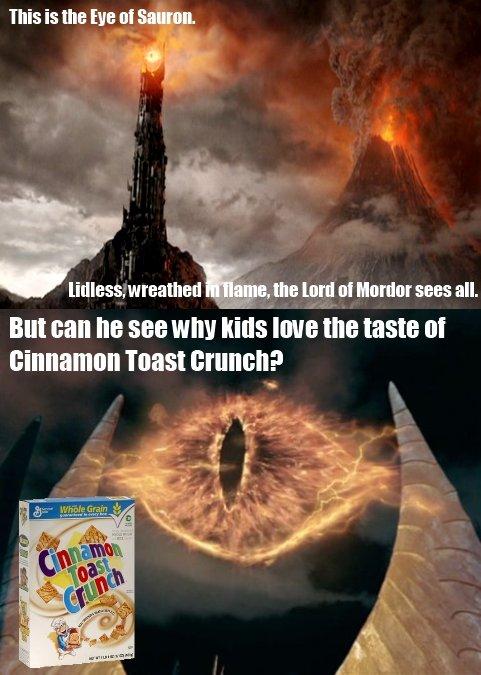
If you happen to have memories of watching TV in the 90s, chances are you might remember the old advertisements they used to run for the Cinnamon Toast Crunch cereal. The general premise of the ads followed the same formula: “Person X is really good at seeing Y, but can they see why kids love the taste of Cinnamon Toast Crunch?”. Inevitably, the answer was always “no”, as adults are apparently so square that they couldn’t wrap their minds around the idea that children happen to like sugar. Difficult concept, I know. Now, obviously, adults aren’t nearly so clueless in reality. In fact, as you’re about to see, even adults who are really rather poor at seeing things can still “see”, so to speak, why men tend to find certain features in women attractive.

Sauron majored in sociology, so he guessed “cultural conditioning”

The first paper up for consideration is a 2010 piece by Karremans et al. The researchers begin by noting that men appear to demonstrate a preference for women with relatively-low waist-to-hip ratios (WHRs). Women with low WHRs tend to have figures that resemble the classic hourglass shape. Low WHRs are thought to be found attractive by men because they are cues to a woman’s fertility status: specifically, women with lower WHRs – around a 0.7 – tend to be more fertile than their more tubular-shaped peers. That said, this preference – just like any of our preferences – does not magically appear in our minds; every preference needs to develop over our lives, and development requires particular input conditions. If these developmental input conditions aren’t met, then the preference should not be expected to form. Simple enough. The question of interest, then, is what precisely these conditions are; what factors are responsible for men finding low WHRs attractive?

One ostensibly obvious condition for the development of a preference for low WHRs might be visual input. After all, if men couldn’t see women’s WHRs – and all those unrealistic expectations of female body type set by the nefarious media – it might seem awfully difficult to develop a taste for them. This poses something of an empirical hurdle to test, as most men have the ability to see, Thankfully for psychological research – though not so thankfully for the subjects of that research – some men, for whatever reasons, happen to have been born blind. If visual input was a key condition for the development of preferences for low WHRs in women, then these blind men should not be expected to show it. While large samples of congenitally blind men are not the easiest to come by, Karremans et al (2010) managed to recruit around 20 of them.

These blind men were presented with two female mannequins wearing tight-fitting dresses. One of these mannequins had a WHR of 0.7 – around what most people rate as the most attractive – and the other had a slightly-higher 0.84. The blind men were asked to feel and rate each mannequins on attractiveness from 1 to 10. Additionally, the researchers recruited about 40 sighted men to complete the task as well: 20 completing it while blindfolded and 20 without the blindfold. Of note is that all data collection was carried out in a van (read: “mobile laboratory room”) because sometimes psychological research is just fun like that.

“How about coming into my van to feel my mannequins?”

The first set of results to consider come from the sighted men, who completed the task with the full use of their eyes: they gave the mannequin with the low WHR a rating of around an 8, whereas the mannequin with the higher WHR received only around a 6.5, as one might expect. In the blindfold condition, this difference was reduced somewhat (with ratings of 7.5 and around 7, respectively), suggesting that visual input might play some role in determining this preference. However, visual input was clearly not necessary: the blind men rated the low WHR mannequin at around a 7, but the high WHR mannequin at about a 6. In the words of the fine people over at Cinnamon Toast Crunch: “even blind men who can’t see much of anything can still see why men love the figures of women with low WHRs”.

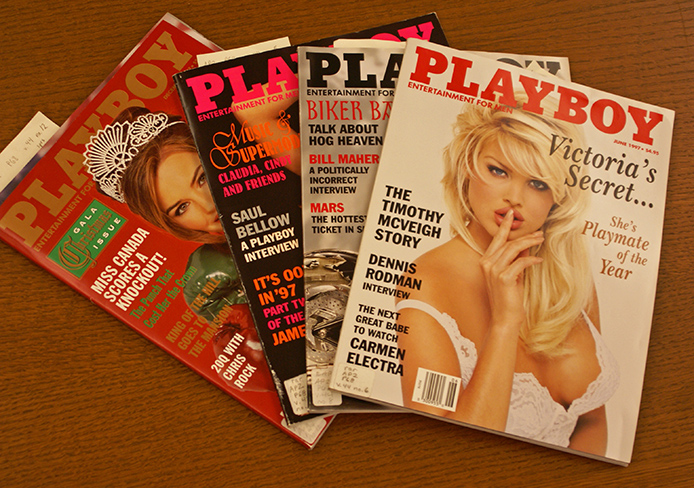
Further evidence from earlier research points towards a similar conclusion (that these preferences are unlikely to be the result of portrayals of women in the media). A paper by Singh (1993) analyzed a trove of data on the female bodies that appeared in Playboy as centerfolds (from 1955-1965 and 1976-1990) and that won Miss America pageants (1923-1987). One might imagine that depictions of women in the media or found to be attractive might change somewhat over six decades if the type of women being portrayed were favored for some arbitrary set of reasons. Indeed, there was one noticeable trend: the centerfolds and pageant winners tended to be getting a little bit skinnier over that time period. Despite these changes in overall BMI, however, the WHR of the groups didn’t vary. Both grounds hovered around a consistent 0.7. Presumably, if blind men were consuming pornography, they would prefer the women depicted in Playboy just as much as non-blind men do.

“We’ll be needing more “databases” for the mobile laboratory room…”

Given the correlation between WHR and fertility, this consistency in men’s preferences should be expected. That’s not to say, of course, that these preferences for low WHR aren’t modifiable. As I mentioned before, every preference needs to develop, and to the extent that certain modifications of that preference would be adaptive in different contexts, we should expect it to fluctuate accordingly. Now that matter of precisely what input conditions are responsible for the development of this preference remain shrouded: while visual inputs don’t seem to be necessary, the matter of which cues are – as well as why they are – are questions that have yet to be answered. For what it’s worth, I would recommend turning research away from the idea that the media is responsible for just about everything, but that’s just me.

References: Karremans, J., Frankenhuis, W., & Arons S. (2010). Blind men prefer a low waist-to-hip ratio. Evolution and Human Behavior, 31, 182-186.

Singh, D. (1993). Adaptive significance of female physical attractiveness: Role of waist to hip ratio. Journal of Personality and Social Psychology, 65, 293-307.

The Best Mate Money Can Buy

There’s a proud tradition in psychological research that involves asking people about how much they value this thing or that one, be it in a supermarket or, for our present purposes, in a sexual partner. Now there’s nothing intrinsically wrong with doing this kind of research, but while there are certain benefits to it, the method does have its shortcomings. One easy way to grasp a potential issue with this methodology is to consider the dating website Okcupid.com. When users create a profile on this site, they are given a standard list of questions to answer in order to tell other people about themselves. Some of these questions deal with matters like, “What are six things you couldn’t do without?” or “what are you looking for in partner?”. The typical sorts of answers you might find to questions like these are highlighted in a video I really like called “The Truth About Being Single“:

“All these people keep interrupting my loneliness!”

The problem with questions like these is that – when they are posed in isolation – their interpretation can get a bit difficult; they often seem to blur the lines between what people require and what they just want. More precisely, the ratings people give to various items or traits in terms of their importance might not accurately capture their degree of actual importance. A quick example concerns cell phones and oxygen. If you were to ask people on Okcupid about five things they couldn’t do without on a day-to-day basis, more people would probably list their phones than the air they breathe. They would also tell you that, in any given year, they likely spend much more money on cell phones than air. Despite this, air is clearly the more important item, as cell phones stop being useful when the owner has long since asphyxiated (even if the cell phone would allow you to go out playing whatever bird-themed game is currently trending).

Perhaps that all seems very mundane, though: “Yes, of course,” you might say, “air is more important than iPhones, but putting ‘I need air’ on your dating profile or asking people how important is the air they breathe on a survey doesn’t tell you much about the person, whereas iPhone ownership makes you a more attractive, cool, and intelligent individual”. While it’s true that “people rate breathing as very important” will probably not land you any good publications or hot dates, when we start thinking about the relative importance of the various traits people look for in a partner, we can end up finding out some pretty interesting things. Specifically, we can begin to uncover what each sex views as necessities and what they view as luxuries in potential partners. The key to this method involves constraining the mate choices people can make: when people can’t have it all, what they opt to have first (i.e. people want air before iPhones if they don’t have either) tells us – to some extent – where their priorities lie.

Enter a paper by Li et al (2002). The authors note that previous studies on mating and partner selection have found sex differences in the importance placed on certain characteristics: men tend to value physical attractiveness in a partner more than women, and women tend to value financial prospects more than men. However, the ratings of these characteristics are not often found to be of paramount importance, relative to ratings of other characteristics like kindness, creativity, or a sense of humor (on which the sexes tend to agree). But perhaps the method used to derive those ratings is missing part of the larger picture, as it was in our air/iPhone example. Without asking people to make tradeoffs between these characteristics, researchers might be, as Li et al put it, “[putting the participants in] the position of someone answering a question about how to spend imaginary lottery winnings”. When people have the ability to buy anything, they will spend proportionately more money on luxuries, relative to necessities. Similarly, when people are asked about what they want in a mate, they might play up the importance of luxuries, rather than necessities if they are just thinking about the traits in general terms.

“I’m spending it all on cans of beans!”

What Li et al (2002) did in the first experiment, then, was to provide 78 participants with a list of 10 characteristics that are often rated as important in a long-term partner. The subjects were told to, essentially, Frankenstein themselves a marriage partner from that list. Their potential partners would start out in the bottom percentile for each of those traits. What this means is that, if we consider the trait of kindness, their partner would be less kind than everyone else in the population. However, people could raise the percentile score of their partner in any domain by 10% by spending a point from their “mating budget” (so if one point was invested in kindness, their partner would now be less kind than 90% of people; if two points were spent, the partner is now less kind than 80% of people, and so on). The twist is that people were only given a limited budget. With 10 traits and 10 percentiles per trait, people would need 100 points to make a partner high in everything. The first budget people started with was 20 points, which requires some tough calls to be made.

So what do people look for in a partner first? That depends, in part, on whether you’re a man or a woman. Women tended to spend the most – about 20% of their initial budget (or 4 points) – on intelligence; men spent comparably in that domain as well, with about 16% of their budget going towards brains. The next thing women tended to buy was good financial prospects, spending another 17% beefing up their partner’s yearly income. Men, on the other hand, seemed relatively unconcerned with their partner’s salary, spending only 3% of their initial budget on a woman’s income. What men seemed much more interested in was getting physical attractiveness, spending about 21% of their initial budget there; about twice what the women spent. The most vital characteristics in a long-term partner, then, seemed to be intelligence and money for women, and attractiveness and intelligence for men, in that order.

However, as people’s mating budget was increased, from 20 points to 60 points, these sex differences disappeared. Both men and women began to spend comparably as their budgets were increased and tradeoffs became less pressing. In other words, once people had the necessities for a relationship, they bought the same kinds of luxuries. These results were replicated in a slightly-modified second study using 178 undergraduates and five traits instead of ten. In the final study, participants were given a number of potential dates to screen for acceptability. These mates were said to be have been rated along the previous 5 characteristics in a high/medium/low fashion. Participants could reveal the hidden ratings of the potential dates for free, but were asked to reveal as few as possible in order to make a decision. As one might expect, men tended to reveal how physically attractive the potential mate was first more than any other trait (43% of the time, relative to women’s 16%), whereas women tended to first reveal how much social status the men had (35% of the time, relative to men’s 16%). Men seem to value good looks and women tend to value access to resources. Stereotype accuracy confirmed.

A now onto the next research project…

This is the reason I liked the initial video so much. The first portion of the video reflects the typical sentiments that people often express when it comes to what they want in a partner (“I just want someone [who gets me/to spend time with/ to sleep next to/ etc]“). These are, however, often expressions of luxuries, rather than necessities. Much like the air we breathe, the presence of the necessities in a potential mate are, more or less, taken for granted – at least until they’re absent, that is. So while traits like “creativity” might make an already-attractive partner more attractive, being incredibly creative will likely suddenly count for quite a bit less if you’re poor and/or unattractive, depending on who you’re trying to impress. I’ll leave the final word on the matter to one of my favorite comedians, John Mulaney, as I think he expresses the point well: “Sometimes I’ll be talking to someone and I’ll be like, “yeah, I’ve been really lonely lately”, and they’ll be like, “well we should hang out!” and I’m like, “no; that’s not what I meant”.

References: Li, N., Bailey, J., Kenrick, D., & Linsenmeier, J. (2002). The necessities and luxuries of mate preferences: Testing the tradeoffs. Journal of Personality and Social Psychology, 82, 947-955.

Interesting Information On Cricket Sex

Our experiences of the goings on in our mind tend to paint a less-than-accurate picture of precisely how the mind is structured. Specifically, we tend to consciously experience the functioning of our mind as, more or less, unified; that there’s some “self” running the show, so to speak. There are a great number of theoretical problems with the idea of a self – that I won’t get into here – which has led to a growing conceptual rejection of it. Rather than some unified self processing all sorts of cognitive information, there are thought to be a series of domain-specific cognitive modules performing a variety of independent tasks using unique sets of information. Though the idea of a “self” has been thrown out in favor of, essentially, very many “sub-selves”, there is still some sense in which the functioning of all these different parts can be considered a psychological “you”: the outputs of all these different modules need to be integrated in some way so as to produce behavior, even if they don’t go through a central self. This is just a round about way of saying that though one part of your brain might want to stick to a diet and another part might wish to break the diet, you – your body, anyway – can’t do both of these things at the same time.

Thankfully, you can do both with the proper temporal spacing.

So we might consider the sum of all these different pieces interacting to be, in some non-technical sense, a psychological “you”. As we’re about to see, however, how precisely we want to define this psychological “you” gets even trickier than that. This is because some aspects of our behavior (and, by extension, our psychological functioning) can be affected by other organisms that happen to be taking up residence in our bodies; organisms that would “prefer” we do things to achieve their evolutionary goals at the expense of our own. This brings us nicely to a recent paper by Adamo et al (2014) examining the sexual behavior of crickets.

The researchers had been collecting crickets for some reason not directly related to matter of pathogens, as far as their paper suggests. However, they eventually noticed that some of the females had stopped laying eggs. When these females were dissected, the researchers noticed that the fatty body inside these females had an iridescent blue sheen. As it turns out, this was indicative of a type of viral infection; it also turns out that this particular virus is spread via sexual contact. Let’s consider the pathogen’s fitness interests for a moment: first, and perhaps most obviously, this virus would prefer that the crickets have sex with some regularity. Since the virus is spread sexually, the more sex the cricket is having, the more opportunities the virus has to find new hosts and reproduce itself. Accordingly, we might imagine that this virus would prefer their hosts are more eager to mate than non-infected crickets.

However, the virus would also prefer that the crickets not behave as if they’re sick. As someone who has just recently recovered from an infection myself, I can attest to the fact that sick animals often behave much differently than healthy ones. Sick animals might try to conserve energy, for instance, opting to spend their energy budget on an immune response to fight off the infection rather than moving around their environment and doing other things. This poses a problem for the sexually transmitted virus, as animals which are conserving their energy budget might not be interested in pursuing mating effort at the same time. So if the virus could prevent this suite of sickness-related behaviors from taking place, it could potentially benefit itself as well.

“Stupid, lazy host; get out of bed and fuck something!”

Now this is all very interesting in the abstract, but is there any evidence that these viruses actually had the ability to manipulate the host’s behavior? Since I wouldn’t be writing about this issue if there wasn’t, yes; there seems to be. Compared to non-infected crickets, the male crickets sporting the infection were quicker to try and court females. In the case of crickets, this means the males started to produce courtship signaling, in the form of “singing”, quicker. Infected males starting singing around 200 seconds after being exposed to females, whereas their uninfected counterparts took a little over 400 seconds to begin the process.  Unfortunately for the eager lovers, there also seemed to be pretty good evidence that the virus had a nasty habit of rendering them sterile, so the mating wasn’t doing the crickets a whole lot of good..

That wasn’t the only behavioral effect of the infection observed, though. The researchers also injected healthy crickets and infected crickets with a bacteria that had been killed by heat prior to the injection. While this renders the bacteria relatively harmless to the crickets, their immune system still responded to what it perceived to be a potential threat. Accordingly, the immune response tended to trigger certain sickness behaviors, like not eating and taking longer to try and court females. However, this was only the case the for non-infected crickets, which now took about 800 seconds to begin courting; the infected crickets showed no sickness behaviors when injected with the dead bacteria and continued on eating and mating as they had beforehand.

While it’s not entirely clear whether the sickness behavior was inhibited as byproduct of the virus partially shutting down its host’s immune response abilities more generally or whether the capacity to inhibit the behavior had been directly selected for, the main point doesn’t change: the viral infection seemed to be having an effect on the host’s behavior and, presumably, this effect was at least partially realized through a change in the host’s psychology. While it’s hard for me to say what, if anything, it’s “like” to be a cricket, to the extent that they feel things like hunger or lust, such feelings might well have been modified by the effects of the infection (making them not lose their appetite in the presence of invading pathogens as healthy crickets did, and making them more eager to court females). Indeed, the results of this study appear to be conceptually similar to the paper suggesting that mosquitoes infected with malaria might preferentially feed from human hosts, owing to the pathogen reproducing in humans and being spread by mosquitoes. The more people the infected mosquitoes bite, the greater the chance the pathogen has to spread, and the parasite seems to be able to push its host in the preferred direction.   

Side effects of infections include an insatiable thirst for human blood and sex…

So while the idea of “the self” is already a theoretical non-starter, even the colloquial sense of the word poses some interesting definitional problems. After all, if we were to label the sum total of the interactions within our brains as “the self” then, in some sense, the effect of the presence of certain pathogens may well be included in the “you” side of this equation, though most of us wouldn’t think of them that way. Some of our preferences are, no doubt, influenced by particular pathogens when they are infecting us, and some of our preferences might also be shaped in a more long-term fashion by the presence of infectious agents present during our development as well. It’s unfortunate that more hasn’t been written about the subject (or at least I haven’t seen too much about it around the psychology departments I’ve been in), as there are likely a great many pathogens that have all sorts of interesting effects on our behavior, from the symbiotes we carry around in body to those trying to make meals of us.

References: Adamo, S., Kovalko, I., Easy, R., & Stoltz, D. (2014). A viral aphrodisac in the cricket Gryllus texensis. The Journal of Experimental Biology, doi:10.1242/jeb.103408