What Are We To Make Of The Term “Race”?

In the language of biology, race has no hard definition. The most basic taxonomic classification that we as humans get without resorting to “eyeballin’ it” is species, the most frequently referred to definition being: a group of organisms capable of interbreeding and producing fertile offspring. All races of humans definitely fall into the same species category (if they didn’t, we’d hardly be calling ourselves humans). Additionally, in terms of our cognitive functioning, it’s unlikely that people were ever selected to encode the races of other people, given that they were not likely to travel far enough to ever really encounter someone of a different race (Kurzban, Tooby, & Cosmides, 2001), not to mention the matter of what selective advantages the coding of other races would bring being unanswered.

So surely that means race is simply an arbitrary social construct with no real underlying differences between groups, right? Well…

“Have fun with that, buddy. I’m going to sit this one out.”

The answer is both a “yes” and a “no”, but we’ll get to that in a minute. Let’s return to that definition of a species first. There is a hypothetical population of mice (A1), all from the same area of the world. Half of that population is randomly selected and moved to a new area (A2), so the two groups are reproductively isolated. It’s unlikely to two groups of mice will evolve in the same direction, as each group will have to deal with different selection pressures and drift. Let’s further say that each generation, you took a sample of mice from A1 and A2 and attempted to breed them, to see if they produced viable offspring. Turns out they do, leaving you quite unsurprised and able to publish your results in “who cares?” monthly . If you continued this experiment long enough, eventually you’d find that some percentage of the mice from the two groups would probably fail to successfully produce viable offspring.

In the span of a single generation then, two groups that used to be the same species would then not (all) be the same species anymore. That wouldn’t happen because of any one sudden change, but would occur because of genetic differences that had been accumulating over time. This suggests that while there is less agreement over what counts as a race, relative to a species, the concept itself need not be discarded despite its fuzziness; it may actually refer to something worth considering, as evolution doesn’t share our penchant for neat and tidy categorization. The example also demonstrates that the term species is not without ambiguity itself, despite it’s clear definition. Consider that all the mice in A1 could successfully reproduce with all the other A1 mice (A1 = A1), all the A2 mice with other A2 mice (A2 = A2), but only a certain percentage of A1s could reproduce with A2s (some A1 = A2 and some other A1 =/= A2). This means that some of the A1 mice could be considered an identical and/or separate species from the A2 mice, depending on your frame of reference. (Another way of putting this would be that the difference between statistically significant and not statistically significant itself is not significant.)

Try to organize these by color, then tell me the exact moment one color transitions to another.
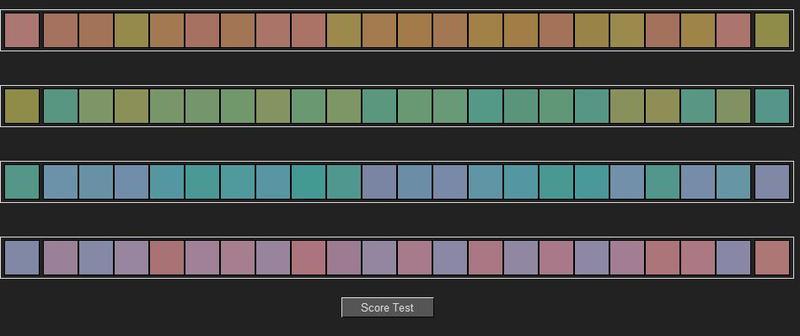
Now, obviously, it hasn’t even come close to that point when it comes to race in people. All humans are still very much the same species, and the degree of genetic diversity between individuals is rather small compared to chimps (Cosmides, Tooby, and Kurzban, 2003). The more general point is that just because that is true, and just because the definition of race generally amounts to an “I know it when I see it”, it doesn’t mean there are no genetic differences between races worth considering (contingent, of course, upon how one defines race, in all its fuzziness).

It is also important to keep in mind that percentage of genetic difference per se does not determine the effect those differences will have. For instance, Cosmides, Tooby, and Kurzban (2003) note:

Within population genetic variance was found to be [approximately] 10 times greater than between-race genetic variance (i.e. two neighbors of the same ‘race’ differ many times more, genetically speaking, than a mathematically average member of one ‘race’ differs from an average member of another).

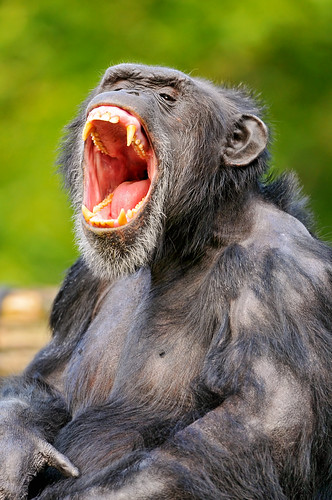
On the same token, the variance in height between the average man and the average women (a few inches) is less than the variance in height within genders (a few feet). I don’t find such statements terribly useful. Sure, the statements may be matters of fact and they may tell us we share a lot more than we don’t, but they in no way speak to the differences that do exist. Men are taller than women overall, and that needs an explanation. Put another way, humans share more – much more – of their DNA with chimpanzees, relative to the amount they do not share. However, the amount they don’t share does not cease to be relevant because of that fact.

*This product has been tested on animals we only share 93% of our DNA with
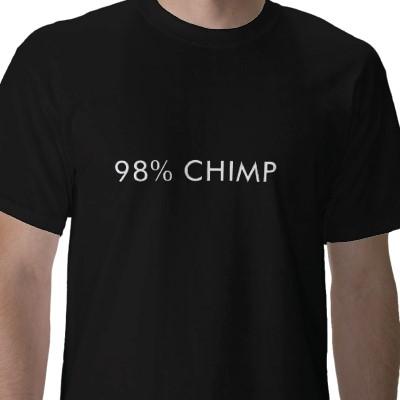
The real question is in what domains do different groups tend to differ from each other and what are the extent of those differences? Are those differences in terms of mean values or variances of a trait? Are they confined to non-psychological factors, like skin and hair color? I will admit near complete ignorance of what an answers to those questions would look like, nor do I feel they’d be particularly easy to obtain in many cases. Some examples could include issues of lactose intolerance among certain populations, sickle cell anemia in others, and the odd fact that while rates of identical twinning tend to be constant across races, the rates of dizyogtic twinning can range from as low as 1/330 in Asian populations to 1/63 among African populations (Segal, 2000). However, the point of this post was not to answer those questions; rather, the point was to demonstrate that such questions need not be immediately shunned because of the definitional issues (of which there are, to restate, plenty of) and political implications that come with the term race.

So while race may be a term that gets an arbitrary or subjective definition across different contexts and people, and while individuals differ more than races do, that does not imply that such a term is useless in all situations. People may disagree on precisely what colors should be considered blue, red, or purple, but that doesn’t mean we should stop thinking about different colors altogether in favor of one single color. It should go without saying that just because differences might/do exist between groups of people in whatever form they do, that’s no justification to treat any person as a representative member of their group rather than an individual, but it’s probably something that should be said more often anyway. So there it is.

References: Cosmides, L., Tooby, J., & Kurzban, R. (2003). Perceptions of race. Trends in Cognitive Sciences, 7, 173-179.

Kurzban, R., Tooby, J., & Cosmides, L. (2001). Can race be erased? Coalitional computation and social categorization. Proceedings of the National Academy of Science, 98, 15387-15392

Segal, N.L. (2000). Entwined Lives: Twins, and What They Tell Us About Human Behavior. Plume.

I Meme You No Harm

...[T]he evidence strongly suggests that war is not a primordial instinct that we share with chimpanzees but a cultural innovation, a virulent meme that began spreading around the world about 10,000 years ago and still infects us. – John Horgan

What a hopeful thought: humans have no innate predisposition for coalitional violence – the large scale version of which we would call war. No. Violence, you see, is a meme; it’s an infection; part of this mysterious “culture” thing, which is not to be conflated in any way with biology. Apparently, it’s also a meme that humans were capable of spreading to chimps, via the introduction of bananas to make naturalistic observations easier. Who knew that fruit came with, basically, a meme of the plot to 28 Days Later?

Bananas: the ultimate catalyst of war?

While this notion of “violence as a meme/infection, not anything innate” may sound hopeful to those who wish to see an end to violence, the babies that they are, it’s also an incredibly dim view. For starters, you know those big canine teeth chimps have? They don’t have them for eating. Rather than being utensils, they’re the biological equivalent of having four mouth-daggers, used mainly to, you guessed it, seriously injure or kill other conspecifics (Alba et al., 2001). Given that for the vast majority of chimpanzee evolution there haven’t been humans consistently handing out bananas – in turn prompting memes for fighting that lead to the evolution of large canine teeth – we can rightly conclude that the origins of coalitional violence go back a bit further than Horgan’s hypothesis would predict.

However, perhaps handing out concentrated resources, in form of bananas, did actually increase violence in some chimp groups (as opposed to allowing researchers to simply observe more of it). This brings us to a question that gets at part of the reason memetics runs into serious problems explaining anything, and why Horgan’s view of innateness seems lacking: why would handing out food increase violence in chimps over any other behavior, such as cooperation or masturbation? Once researchers provided additional food, that meant there were more resources available to be shared, or additional leisure time available, leading idle hands to drift to the genitals. So to rephrase the question in terms of memes: why would we expect additional resources to successfully further the reproduction of (or even create) memes for violence specifically, when they could have had any number of other effects?

Bananas, free time, genitals; do you see the picture I’m painting here?

Before going any further, it would be helpful to clarify what is meant by the term “meme”. I’ll defer to Atran’s (2002) use of the term: “Memes are hypothetical cultural units, an idea or practice, passed on by imiation. Although nonbiological, they undergo Darwinian selection, like genes. Cultures and religions are supposedly coalitions of memes seeking to maximize their own fitness, regardless of the fitness costs for their human hosts”. As a thought experiment for understanding how evolution could work in a non-biological setting, the term works alright; when the idea runs up against reality, there are a lot of issues. I’d like to focus on what I feel is one of the biggest issues: the inability of meme theory to differentiate between the structure of the mind and the structure of the meme.

Memes aren’t supposed to reproduce and spread randomly. For starters, they’re generally species-specific: if you put a songbird in the same room as cat, provided the bird doesn’t end up dead, the “meme” of birdsong will never transfer to the cat no matter how much singing the bird does. You can show chimpanzees pictures of LOLcats their entire life, and I don’t think you’ll ever get so much as a chuckle from the apes, much less any imitation. Even within species, the spread of memes is not random. Let’s say I read something profoundly stupid about evolutionary psychology and, out of frustration, slam my head onto the keyboard to momentarily distract myself from the pain. The head-slam will generate a string of text, but that text won’t inspire people to replicate it and pass it along. What makes that bit of text less likely to be passed around then a phrase like, “Tonight. You”?

Sometimes, bananas get tired of waiting for idle hands.

An obvious candidate answer would be that one phrase appeals to our particular psychology in some way, whereas the other doesn’t. This tells us that both within- and between-species, what information gets passed on is going to be highly dependent on the existing structure of the mind; specifically, what kind of information the existing modules are already sensitive towards. To explain why a meme for violence – specifically violence – spreads throughout a population, you’d need to reference an organism already prepared for violence. Memes don’t create violence in a mind not already prepared for violence in certain situations; some degree of violence would need to be innate. Similarly, viruses don’t create the ability of host cells to reproduce them; they use the preexisting machinery for that job. In the same fashion, you’d need to reference an organism already prepared for birdsong to explain why such a meme would catch on in birds, but not cats or chimps.

I’m reminded of a story that’s generally used to argue against the notion of the universe, or our planet, being “fine-tuned” for life, but I think it works well to torpedo Horgan’s suggestion further. It goes something like this:

One day, a puddle awoke after a rainstorm. The puddle thought to itself, “Well, isn’t this interesting? The hole I find myself laying in seems remarkably well-suited to me; in fact, the hole seems to fit my shape rather perfectly. It seems incredibly improbable that I would end up in a hole that just happens to fit me, of all the possible places I could have ended up. Therefore, I can only conclude the hole was designed to have me in it”.

The shape of the water, obviously, is determined by the shape of its container – the hole. Likewise, the shape that information takes in a mind is determined by the shape of that mind – its modules, that all perceive, process, manipulate, and create information in their own fashion, rather than simply reproduce a high-fidelity copy (Atran, 2002). If you take away the container (the mind) you’ll quickly discover that the water (memes) have no shape of their own, and that a random string of words is as good of a meme as any.

A good example of both a meme, and the depth of thought displayed by puddles.

Further, I don’t see the concept of a meme adding anything above and beyond what predictions can already be drawn from the concept of a modular mind, nor do I think you can derive already existing states of affairs from meme theory. If the human mind has evolved to respond violently towards certain situations, contingent on context, we’re in a stronger position to predict when and why violence will occur than if we just say, “there’s a meme for violence”. As far as I can tell, the latter proposition makes few to no specific predictions, harking back to the illusion of explanatory depth. (“Norms, I’d like you to meet Memes. No one can seem to figure out much about either of you, so I’m sure you two can bond over that.”)

Though I have yet to hear any novel or useful predictions drawn from meme theory, I have heard plenty of smug comments along the lines of, “religion is just harmful meme, parasitizing your weak mind (and mine is strong enough to resist)”, or the initial quote. Until I hear something useful coming from the field of memetics, it’s probably best to pull back on the non-explanations passed off as worthwhile ones.

References: Alba, D.M., Moya-Sola, S., & Kohler, M. (2001). Canine reduction in Miocene hominid Oreopithecus bambolii. behavioral and evolutionary implications. Journal of Human Evolution, 40, 1-16  

Atran, S. (2002). In gods we trust: The evolutionary landscape of religion. New York: Oxford University Press.

So Drunk You’re See Double (Standards)


Jack and Jill (both played by Adam Sandler, for our purposes here) have been hanging out all night. While both have been drinking, Jill is substantially drunker than Jack. While Jill is in the bushes puking, she remembers that Jack had mentioned earlier he was out of cigarettes and wanted to get more. Once she emerges from the now-soiled side of the lawn she was on, Jill offers to drive Jack to the store so he can buy the cigarettes he wants. Along the way, they are pulled over for drunk driving. Jill wakes up the next day and doesn’t even recall getting into the car, but she regrets doing it.

Was Jill responsible for making the decision to get behind the wheel?

More importantly, should the cop had let them off in the hopes that the drunk driving would have stopped this movie from ever being made?

Jack and Jill (again, both played by Adam Sandler, for our purposes here) have been hanging out all night. While both have been drinking, Jill is substantially drunker than Jack. While Jill is in the bushes puking, she remembers that Jack had mentioned earlier he thought she was attractive and wanted to have sex. Once she emerges from the now-soiled side of the lawn she was on, Jill offers to have sex with Jack, and they go inside and get into bed together. The next morning, Jill wakes up, not remembering getting into bed with Jack, but she regrets doing it.

Was Jill responsible for making the decision to have sex?

More importantly, was what happened sex, incest, or masturbation? Either way, if Adam Sandler was doing it, it’s definitely gross.

According to my completely unscientific digging around discussions regarding the issue online, I can conclusively state that opinions are definitely mixed on the second question, though not so much on the first. In both cases, the underlying logic is the same: person X makes decision Y willingly while under the influence of alcohol, and later does not remember and regrets Y. As seen previously, slight changes in phrasing can make all the difference when it comes to people’s moral judgments, even if the underlying proposition is, essentially, the same.

To explore these intuitions in one other context, let’s turn down the dimmer, light some candles, pour some expensive wine (just not too much, to avoid impairing your judgment), and get a little more personal with them: You have been dating your partner – let’s just say they’re Adam Sandler, gendered to your preferences – who decided one night to go hang out with some friends. You keep in contact with your partner throughout the night, but as it gets later, the responses stop coming. The next day, you get a phone call; it’s your partner. Their tone of voice is noticeably shaken. They tell you that after they had been drinking for a while, someone else at the bar had started buying them drinks. Their memory is very scattered, but they recall enough to let you know that they had cheated on you, and, that at the time, they had offered to have sex with the person they met at the bar. They go on to tell you they regret doing it.

Would you blame your partner for what they did, or would you see them as faultless? How would you feel about them going out drinking alone the next weekend?

If you assumed the Asian man was the Asian woman’s husband, you’re a racist asshole.

Our perceptions of the situation and the responsibilities of the involved parties are going to be colored by self-interested factors (Kearns & Fincham, 2005). If you engage in a behavior that can do you or your reputation harm – like infidelity – you’re more likely to try and justify that behavior in ways that remove as much personal responsibility as possible (such as: “I was drunk” or “They were really hot”). On the other hand, if you’ve been wronged you’re also more likely to try and lump as much blame on others as possible on the party that wronged you, discounting environmental factors. Both perpetrators and victims bias their views on the situation, they just tend to do so in opposite directions.

What you can bet on, despite my not having available data on the matter, is that people won’t take kindly to having either their status as “innocent from (most) wrong-doing” or a “victim” be questioned. There is often too much at stake, in one form or another, to let consistency get in the way. After all, being a justified victim can easily put one into a strong social position, just as being known as one who slanders others in an unjustified fashion can drop you down the social ladder like a stone.

References: Kearns, J.N. & Fincham, F.D. (2005). Victim and perpetrator accounts of interpersonal transgressions: Self-serving or relationship-serving biases? Personality and Social Psychology Bulletin, 31, 321-333

Performance Enhancing Surgery

In the sporting world – which I occasionally visit via a muted TV on at a bar – I’m told that steroid use is something of hot topic. Many people don’t seem to take too kindly to athletes that use these performance enhancing drugs, as they are seen as being dangerous and giving athletes an unfair advantage. As I’ve written previously, when concerns for “fairness” start getting raised, you can bet there’s more than just a hint of inconsistency lurking right around the corner.

It starts with banning steroids, then, before you know it, I won’t be able to use my car in the Tour de France.

On the one hand, steroids certainly allow people to surpass the level of physical prowess they could achieve without them; I get that. How that makes them unfair isn’t exactly obvious, though. Surely, other athletes are just as capable of using steroids, which would level the playing field. “But what about those athletes who don’t want to use steroids?” I already hear you objecting. Well, what about those athletes who don’t want to exercise? Exercise and exercise equipment also allows people to surpass the level of physical prowess they could achieve without them, but I don’t see anyone lining up to ban gym use.

Maybe the gym and steroids differ in some important, unspecified way. Sure, people who work out more may have an advantage of those who eschew the gym, but those advantages are not due to the same underlying reason that come with steroid use. How about glasses or contacts? Now, to the best of my provincial knowledge of the sporting world, no one has proposed we ban athletes from correcting their vision. As contact lenses allow one to artificially improve their natural vision, that could be a huge leg up, especially for any sports that involve visual acuity (almost all of them). A similar tool that allowed an athlete to run a little faster, throw a little faster, or hit a little harder, to makeup for some pre-existing biological deficit in strength would probably be ruled out of consideration from the outset.

“Just try and tackle me now, you juiced up clowns!”

I don’t think this intuition is limited to sports; we may also see it in the animosity directed towards plastic surgery. Given that most people in the world haven’t been born with my exceptional level of charm and attractiveness, it’s understandable that many turn to plastic surgery. A few hundred examples of people’s thoughts surrounding plastic surgery can be found here. If you’re not bored enough to scroll through them, here’s a quick rundown of the opinions you’ll find: I would definitely get it; I would never get it; I would only get it if I was disfigured by some accident – doing it for mere vanity is wrong.
Given that the surgery generally makes people more attractive (Dayan, Clark, & Ho, 2004), the most interesting question is why wouldn’t people want it, barring a fear of looking better? The opposition towards plastic surgery – and those who get it – probably has a lot to do with the sending and receiving of honest signals. In order for a signal to be honest, it needs to be correlated to some underlying biological trait. Artificially improving facial attractiveness by normalizing traits somewhat, or improving symmetry, may make the bearer more physically attractive, but those attractive traits would not be passed on to their future offspring. It’s the biological equivalent of paying for a purchase using counterfeit bills.

“I couldn’t afford plastic surgery, so these discount face tattoos will have to do”

Similar opposition can sometimes be seen even towards people who choose to wear makeup. Any attempts to artificially increase one’s attractiveness have a habit of drawing its fair share of detractors. As for why there seems to be a difference between compensating for a natural disadvantage (in the case of contacts) in some cases, but not for surpassing natural limits (in the case of steroids or plastic surgery) in others, I can’t definitively say. Improving vision is somehow more legitimate than improving one’s appearance, strength, or speed (in ways that don’t involve lifting weights and training, anyway).

Perhaps it has something to do with people viewing attractiveness, strength, and speed as traits capable of being improved through “natural” methods – there’s no machine at the gym for improving your vision, no matter how many new years resolutions you’ve made to start seeing better. Of course, there’s also no machine at the gym for improving for your facial symmetry, but facial symmetry plays a much greater role in determining your physical attractiveness relative to visual acuity, so surgery could be viewed as form of cheating, in the biological sense, to a far greater extent than contacts.

References: Dayan, S., Clark, K., & Ho, A.A. (2004). Altering first impressions after plastic surgery. Aesthetic Plastic Surgery, 28, 301-306.

Rushing To Get Your Results Out There? Try A Men’s Magazine.

I have something of an issue with the rush some researchers feel to publicize their findings before the research is available to be read. While I completely understand the desire for self-aggrandizement and to do science-via-headlines, it puts me in a bind. While I would enjoy picking apart a study in more depth, I’m unable to adequately assess the quality of work at the time when everyone feels the urge to basically copy and paste the snippet of the study into their column and talk about how the results offend or delight them.

Today I’m going to go out on a limb and attempt to critique a study I haven’t read. My sole sources of information will be the abstract and the media coverage. It’s been getting a lot of press from people who also haven’t read it – and probably never will, even after it becomes available – so I think it’s about time there’s a critical evaluation of the issue which is: are men’s magazines normalizing and legitimizing hostile sexism?

“50 new ways for men to help keep women down? You have my undivided attention, magazine”

So let’s start off with what has been said about the study: a numbers of quotes from “lad’s mags” (the English versions of Maxim, as far as I can tell) and convicted rapists were collected; forty men and women were not able to reliably group them into their respective categories. When the quotes were presented as coming from rapists, men tended to identify with them less, relative to when they were presented as coming from a men’s magazine. The conclusion, apparently, is that these magazines are normalizing and legitimizing sexism. Just toss in some moralizing about protecting children and you have yourself a top-shelf popular psychology article.

The first big question the limited information does not address is: how and why were these specific quotes selected? (Examples of the quotes can be found here.) I’m going to go out on another limb that seems fairly stable and say the selection process was not random; a good deal of personal judgment probably went into selecting these quotes for one reason or another. If the selection process was not random, it casts into doubt whether these quotes are representative of the views of the magazine/rapists on the whole regarding women and sex.

Their research staff, hard at work.

Perhaps it doesn’t matter as to the views on the whole; simply that the magazines contained any passages that might have been confused for something a rapist might say is enough to make the point for some people. There is another issue looming, however: though no information is given, the quotes look to be edited to some degree; potentially, a very large one. Ellipses are present in 12 of the 16 quotes, with an average of one-and-a-half per quote. At the very least, even if the editing wasn’t used selectively, none of the quotes are in context.

Now, I have no idea how much editing took place, nor what contexts they were originally in, (perhaps all contexts were horrific) but that’s kind of the point. There’s no way to assess the methods used in selecting their sample of magazine and rapists quotes and presenting them until the actual paper comes out - assuming the paper explains why these particular quotes were selected and how they were edited, of course -  at which point it will be old news that no one will care about anymore.

How about the results? That men were quicker to identify with quotes they thought weren’t those of rapists doesn’t tell us a whole lot more than men seem to have some crazy aversion towards wanting to identify with rapists. I honestly can’t imagine why that might be the case.

Go ahead and tell her you sometimes agree with things rapists say. There’s no way that could go badly.

Assuming that the results of the quote-labeling part of this study are taken at face-value, what would they tell us? If they merely serve to demonstrate that people aren’t good at attributing some quotes about sex to rapists or non-rapists, fine; perhaps rapists don’t use language that immediately distinguishes them from non-rapists, or people just aren’t that good at telling the two apart. The content of a quote does not change contingent on the speaker, much like the essence of a person doesn’t live on through objects they touched. That sweater you bought at that Nazi’s garage sale is not a Nazi-sweater, just a boring old sweater-sweater.

It seems that the authors want to go beyond that conclusion towards one that says something about the effects these magazines may have on ‘normalizing’ or ‘legitimizing’ a behavior, or language, or sexism, or something. I feel about as inclined to discuss that idea as the authors felt to attempt and demonstrate it, which is to say not at all from what I’ve seen so far.

I will, however, say this: I’m sure that if you gave me the same sources used for this study – the men’s magazines and the book of rapist interviews – and allowed me to pick out my own set of quotes, I could find very different results where people can easily distinguish between quotes from rapists and men’s magazines. That would then conclusively demonstrate these magazines are not normalizing or legitimizing sexism, right?

Hardcore Porn-etry

Sex and sexuality are hot button topics. Not surprisingly, they are topics that also draw a lot of powerful sentiments out of people that have something of a long-distance relationship with reality. Opinions for the opposition can range from “porn is degrading for daring to depict women enjoying sex, causal or otherwise, and is a tool of men for oppressing women” to “The idea of porn isn’t inherently offensive, but [porn needs to do more to depict love and caring/it's harmful for children, who need to be protected from its grasp/has some unfavorable side-effects that need to be dealt with/is too commonly used, and I'm running out of clean socks]“.

“Oh yeah; that’s it. You like cuddling, you whore. You love your satisfying and loving relationship, don’t you, you dirty girl?”

Rather than continue on with my normal style of critique, I’ve decided to give it another go in limerick form. I will return to this issue in time, once a certain article comes out from behind a journal’s six-month embargo wall.

Porn, it would seem,

has a reputation unclean.

It seems innocuous at first,

but soon gets much worse,

making our sexuality mean.


“Those who watch porn”,

the activists shout with scorn,

“will soon turn to rape

because of that tape,

and women will be left to mourn”


“While it might hurt your wrists,”

the research insists,

“There’s no connection

between a porn-based erection,

and sex in which someone resists”.


Still feeling the alarm

because porn just must do harm,

“Then the effects are more subtle,”

is the proffered rebuttal

“and leaves men with no sexual charm.


All those men will think,

when they catch some girl’s wink,

that she likes it rough,

and she’ll do all that nasty stuff,

without so much as a blink”


The research is taken aback

by this newly formed attack.

It seems a lot like the last,

as if formulated too fast

and delivered by a similar quack


“It sounds like you’re reaching,

in the service of preaching.

Before you celebrate,

you’d be well-served to demonstrate

that it’s actually the porn doing the teaching


It seems reasonable,

or, at the very least, conceivable,

that porn’s not to blame

and is far more tame

than you feel is believable.


If people can tell the difference between

reality and the porn on a screen,

they are capable of inquiring

about what their partner is desiring,

instead of relying on a fantasy sex scene”


Perhaps there’s some underlying reason

for this open porn-hunting season:

If decided by a cognitive system,

that “porn harms” is the dictum

Other ideas may as well be treason.

Is Working Together Cooperation?

“[P]rogress is often hindered by poor communication between scientists, with different people using the same term to mean different things, or different terms to mean the same thing…In the extreme, this can lead to debates or disputes when in fact there is no disagreement, or the illusion of agreement when there is disagreement” – West et al. (2007)

I assume most of you are little confused by the question, “Is working together cooperation?” Working together is indeed the very first definition of cooperation, so it would seem the answer should be a transparent “yes”. However, according to a paper by West et al. (2007), there’s some confusion that needs to be cleared up here. So buckle up for a little safari into the untamed jungles of academic semantic disagreements.

An apt metaphor for what clearing up confusion looks like.

West et al. (2007) seek to define cooperation as such:

Cooperation: a behavior which provides a benefit to another individual (recipient), and which is selected for because of its beneficial effect on the recipient. [emphasis, mine]

In this definition, benefits are defined in terms of ultimate fitness (reproductive) benefits. There is a certain usefulness to this definition, I admit. It can help differentiate between behaviors that are selected to deliver benefits from behaviors that deliver benefits as a byproduct. The example West et al. use is an elephant producing dung. The dung an elephant produces can be useful to other organisms, such as a dung beetle, but the function of dung production in the elephant is not to provide a benefit the beetle; it just happens to do so as a byproduct. On the other hand, if a plant produces nectar to attract pollinators, this is cooperation, as the nectar benefits the pollinators in the form of a meal, and the function of the nectar is to do so, in order to assist in reproduction by attracting pollinators.

However, this definition has some major drawbacks. First, it defines cooperative behavior in terms of actual function, not in terms of proper function. An example will make this distinction a touch clearer: let’s say two teams are competing for a prize in a winner-take-all game. All the members of each team work together in an attempt to achieve the prize, but only one team gets it. By the definition West et al. use, only the winning team’s behavior can be labeled “cooperation”. Since the losers failed to deliver any benefit, their behavior would not be cooperation, even if their behavior was, more or less, identical. While most people would call teamwork cooperation – as the intended goal of the teamwork was to achieve a mutual goal – the West et al. definition leaves no room for this consideration.

I’ll let you know which team was actually cooperating once the game is over.

West et al. (2007) also seem to have a problem with the term “reciprocal altruism”, which is basically summed up by the phrase, “you scratch my back (now) and I’ll scratch yours (at some point in the future)”.  The authors have a problem with the term reciprocal altruism because this mutual delivery of benefits is not altruistic, which they define as such:

Altruism: a behavior which is costly to the actor and beneficial to the recipient; in this case and below, costs and benefits are defined on the basis of the lifetime direct fitness consequences of a behavior.

Since reciprocal altruism is eventually beneficial to the individual paying the initial cost, West et al. (2007) feel it should be classed as “reciprocal cooperation”. Except there’s an issue here: Let’s consider another case: organism X pays a cost (c) to deliver a benefit (b) to another organism, Y, at some time (T1). At some later time (T2), organism Y pays a cost (c) to deliver a benefit (b) back to organism X. So long as (c) < (b), they feel we should call the interaction between X and Y cooperation, not reciprocal altruism.

Here’s the problem: the future is always uncertain. Let’s say there’s a parallel case to the one above, except at some point after (T1) and before (T2), organism X dies. Now, organism X would be defined as acting altruistically (paid a cost to deliver a benefit), and organism Y would be defined as acting selfishly (took a benefit without repaying). What this example tells us is that a behavior can be classed as being altruistic, mutually beneficial, cooperative, or selfish, depending on a temporal factor. In terms of “clearing up confusion” about how to properly use a term or classify a behavior, the definitions provided by West et al. (2007) are not terribly helpful. They note as much, when they write, “we end with the caveat that: (viii) classifying behaviors will not always be the easiest or most useful thing to do” (p.416), which, to me, seems to defeat the entire purpose of this paper.

“We’ve successfully cleared up the commuting issue, though using our roads might not be the easiest or most useful thing to do…”

One final point of contention is that West et al. (2007) feel “…behaviors should be classified according to their impact on total lifetime reproductive success” (emphasis, mine). I understand what they hope to achieve with that, but they make no case whatsoever for why we should stop considering the ultimate effects of a behavior at the end of an organism’s individual lifetime. If an individual behaves in a way that ensures he leaves behind ten additional offspring by the time he dies, but, after he is dead, the fallout from those behaviors further ensures that none of those offspring reproduce, how is that behavior to be labeled?

It seems to me there are many different ways to think about an organism’s behavior, and no one perspective needs to be monolithic across all disciplines. While such a unified approach no doubt has its uses, it’s not always going to clear up confusion.

References: West, S.A., Griffin, A.S., & Gardner, A. (2007). Social semantics: Altruism, cooperation, mutualism, strong reciprocity and group selection. Journal of Evolutionary Biology, 20, 415-432

Discount Engagement Rings

One day, a man is out shopping for an engagement ring in preparation to pop the question to his girlfriend. After a browse through a local jewelry store, he finds what he thinks is the perfect ring: It costs $3000, and even though he’s a man of modest means, he figures he can just afford it. As he prepares to make his purchase, another customer walks up to him and informs the man that the jewelry store down the block is having a going out a business sale and selling an identical ring for only $300.

What’s the boyfriend to do? Clearly, the ring on a 90% discount is the better deal, but something about buying a discount engagement ring just might not sit right with some people. While I don’t have any data on the matter, I could imagine that if the girlfriend in question found out that her (previously) stunning engagement ring was bought at a steep discount, she probably wouldn’t be pleased with her boyfriend’s financial responsibility, and that young bachelor who moved in down the hall might seem just a little more tall, dark, and handsome.

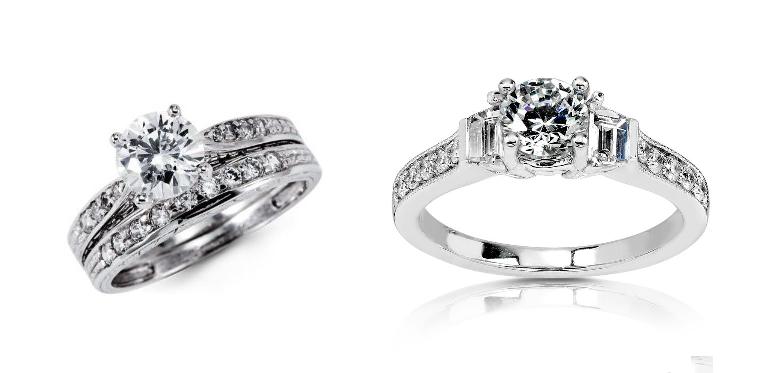
One of these rings will lead to a lifelong marriage and the other to not having a girlfriend; neither one leads to sex with that woman.

Pictured above is a $3000 diamond ring and a $300 cubic zirconia ring; try and tell the difference just by looking (good luck). The reason that a cubic zirconia ring, as opposed to traditional diamond one, would probably not sit well with many women is not because of any noticeable aesthetic quality of the ring itself.  There are, apparently, a number of ways to test and see whether you have a diamond or not, but that these tests exist (and can often be inconclusive to many) demonstrates that untrained people without special tools or knowledge have a hard time telling the two apart (which the comments confirm; many suggest the best way to tell them apart is always to ask an expert). In the specific case I gave initially, the two rings would, in fact, be identical in design and material, so the only difference would be the cost.

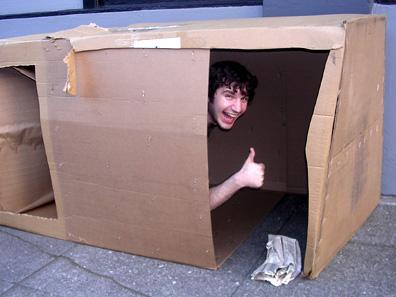
In the case of engagement rings, however, cost is the point. The high cost of an engagement ring functions as an honest signal; not honest in sense that they ensure fidelity or a lasting relationship, but honest in the sense that the signal is hard to fake. A poorer man could not afford a more expensive ring and his rent and his drinking problem. Dave Chapelle summed up this principle nicely when he said, “If a man could fuck a woman in a cardboard box, he wouldn’t buy a house”.

Not only does he still get laid all the damn time, but he didn’t have to give up drinking either.

This is precisely the reason people care about whether there’s a diamond or a cubic zirconia in jewelry; while both are sparkly, only one represents an honest signal, where the other is a fake signal that does not reliably distinguish between the ability to invest and inability to do so; one can signal a willingness to invest, whereas the other does not signal as well.

Examples of signaling abound in the biological world, and for good reason: when the sex that does the most investing in offspring – typically the female – is seeking out a mate, they need to assess the quality of the many potential mates. Since the investing one will be stuck with the consequences, good or bad, for a long time, it’s in their best interests to be more selective to get the best package of genes and/or investment. Males displaying costly ornaments – like peacocks – or behaviors – like bowerbirds – are able to demonstrate they can afford to shoulder the hard to fake costs involved in growing/maintaining them and still survive and flourish; they have been “tested” and they passed, guaranteeing their fitness to the choosy opposite sex (Zahavi, 1975).

We’ve all dealt with the inconvenience of pants that are too long at some point: you occasionally step on them, they shred as you walk along the street, they get dirty as they drag, water soaks up the back of them and feels awful on your legs, and that’s only for pants that a slightly too long. Imagine having a pair of jeans that happen to be a few feet too long, that you make yourself, you can never take off, and all your prospective partners will judge you by their quality. Also, lions are trying to eat you.

Seriously, this thing is practically begging to be killed.

Only those who are able to find the required materials, invest the time and skill in building, cleaning, and maintaining the pants would be able to keep them in viewable shape. Further, those pants would be serious inconvenience when it comes to doing just about anything, so only those who were particularly able would be able to maintain garments like them and still function. Lazy, unskilled, careless, and/or clumsy people would reflect those unfavorable qualities in the state of their pants. One could take off the pants to avoid all the wasteful insanity, but in doing so they’d be all but committing themselves to a lifetime of celibacy, as those still wearing the pants would attract the partners.

If you’re a good observer – and I know you are – you’ll probably have noticed that costly signaling can take many forms: from engagement rings, to bodily ornaments, to behavior. Costly signaling is relatively context independent: the important factor is merely that the behavior is hard to fake and expensive, in terms of time, money, energy, foregone opportunities, risk, etc. It can be used for a variety of goals, such as courting mates, impressing potential allies, or intimidating rivals. We all engage in it, to varying degrees, in different ways, for several purposes, likely without realizing most of it (Miller, 2009). It’s something fun to think about next time you slip into an expensive designer shirt or rail against the evils of branded products.

References: Miller, G. Spent: Sex, Evolution, and Consumer Behavior. New York, NY: Viking

Zahavi, A. (1975). Mate selection – a selection for a handicap. Journal of Theoretical Biology, 53, 205-214

Is Description Explanation?

[Social Psychology] has been self-handicapped with a relentless insistence on theoretical shallowness: on endless demonstrations that People are Really Bad at X, which are then “explained” by an ever-lengthening list of Biases, Fallacies, Illusions, Neglects, Blindnesses, and Fundamental Errors, each of which restates the finding that people are really bad at X. Wilson, for example, defines “self-affirmation theory” as “the idea that when we feel a threat to our self-esteem that’s difficult to deal with, sometimes the best thing we can do is to affirm ourselves in some completely different domain.” Most scientists would not call this a “theory.” It’s a redescription of a phenomenon, which needs a theory to explain it. – Steven Pinker

If you’ve sat through (almost) any psychology course at any point, you can probably understand Pinker’s point quite well (the full discussion can be found here). The theoretical shallowness that Steven references was the very dissatisfaction that drew me towards evolutionary theory so strongly. My first exposure to evolutionary psychology as an undergraduate immediately had me asking the sorely missing “why?” questions so often that I could have probably been mistaken for an annoying child (as if being an undergraduate didn’t already do enough on that front).

In keeping with the annoying child theme, I also started beating up other young children, because I love consistency.

That same theoretical shallowness has returned to me lately in the form of what are known as “norms”. As Fehr and Fischerbacher (2004) note, “…it is impossible to understand human societies without an adequate understanding of social norms”, and “It is, therefore, not surprising that social scientists…invoke no other concept more frequently…”. Did you read that? It’s impossible to understand human behavior without norms, so don’t even try. Of course, in the same paragraph they also note, “…we still know very little about how they are formed, the forces determining their content, how and why they change, their cognitive and emotional underpinnings, how they relate to values, how they shape our perceptions of justice and it’s violations, and how they are shaped by and shape our neuropsychological architecture”. So, just to recap, it’s apparently vital to understand norms in order to understand human behavior, and, despite social scientists knowing pretty much nothing about them, they’re referenced everywhere. Using my amazing powers of deduction, I only conclude that most social scientists think it’s vital they maintain a commitment to not understanding human behavior.

By adding the concept of “norms”, Fehr and Fischerbacher (2004) didn’t actually add anything to what they were trying to explain (which was why some uninvolved bystanders will sometimes pay a generally small amount to punish a perceived misdeed that didn’t directly affect them, if you were curious), but instead seemed to grant an illusion of explanatory depth (Rozenblits & Keil, 2002). It would seem neuroscience is capable of generating that same illusion.

This thing cost more money than most people see in a lifetime; it damn sure better have some answers.

Can simply adding irrelevant neuroscience information to an otherwise bad explanation suddenly make it sound good? Apparently, that answer is a resounding “yes”, at least for most people who aren’t neuroscience graduate students or above. Weisburg et al (2008) gave adults, students in a neuroscience class, and experts in the neuroscience field a brief description of a psychological phenomena, and then offered either a ‘good’ or a ‘bad’ explanation of the phenomena in question. In keeping with the theme of this post, the ‘bad’ explanations were simply circular, redescriptions of the phenomena (or, as many social psychologists would call it, a theory). Additionally, those good and bad explanations also came either without any neuroscience, or with a brief and irrelevant neuroscience tidbit tacked on that described where some activity occurs in a brain scan.

Across all groups, unsurprisingly, good explanations were rated as being more satisfying than bad explanations. However, the adults and the students rated bad explanations with the irrelevant neuroscience information as actually being on the satisfying side of things, and among the students, good explanations with neuroscience sounded better as well. Only those in the expert group did not find the irrelevant neuroscience information more satisfying; if anything, they found it less so – making good explanations less satisfying, as compared to the same explanation without the neuroscience – as they understood that the neuroscience was superfluous and used awkwardly.

This cognitive illusion is quite fascinating: descriptions appear to be capable of playing the role of explanations in some cases, despite them being woefully ill-suited for the task. This could mean that descriptions may also be capable of playing the role of justifications, by way of explanations, just try not to convince yourself that I’ve explained why they function this way.

References: Fehr, E. & Fischerbacher, U. (2004). Third-party punishment and social norms. Evolution and Human Behavior, 25, 63-87.

Rozenblit, L. & Keil, F. (2002). The misunderstood limits of folk science: an illusion of explanatory depth. Cognitive Science, 26, 521-562

Weisberg, D.S., Keil, F.C., Goodstein, J. Rawson, E., & Gray, J.R. (2008). The seductive allure of neuroscience explanations. The Journal of Cognitive Neuroscience, 20, 470-477

A Sense Of Entitlement (Part 2)

One of the major issues that has divided people throughout recorded human history is precisely the matter of division – more specifically, how scarce resources ought to be divided. A number of different principles have been proposed, including: everyone should get precisely the same share, people should receive a share according to their needs, and people should receive a share according to how much effort they put in. None of those principles tend to be universally satisfying. The first two open the door wide for free-riders who are happy to take the benefits of others’ work while contributing none of their own; the third option helps to curb the cheaters, but also leaves those who simply encounter bad luck on their own. Which principles people will tend to use to justify their stance on a matter will no doubt vary across contexts.

If you really wanted toys – or a bed – perhaps you should have done a little more to earn them. Damn entitled kids…

The latter two options also open the door for active deception. If I can convince you that I worked particularly hard – perhaps a bit harder than I actually worked – then the amount I deserve goes up. This tendency to make oneself appear more valuable than one actually is is widespread, and one good example is that about 90% of college professors rate themselves above average in teaching ability. When I was collecting data on women’s perceptions of how attractive they thought they were, from 0 to 9, I don’t think I got a single rating below a 6 from over 40 people, though I did get many 8s and 9s. It’s flattering to think my research attracts so many beauties, and it certainly bodes well for my future hook-up prospects (once all these women realize how good looking and talented I keep telling myself I am, at any rate).

An alternative, though not mutually exclusive, path to getting more would be to convince others that your need is particularly great. If the marginal benefits of resources flowing to me are greater than the benefits of those same resources going to you, I have a better case for deserving them. Giving a millionaire another hundred dollars probably won’t have much of an effect on their bottom line, but that hundred dollars could mean the difference between eating or not for some people. Understanding this strategy allows one to also understand why people working to change society in some way never use the motto, “Things are pretty good right now, but maybe they could be better”.

Their views on societal issues are basically the opposite of their views on pizza.

This brings us to the science (Xiao & Bicchieri, 2010). Today, we’ll be playing a trust game. In this game, player A is given an option: he can end the game and both players will walk away with 40 points, or he can trust and give 10 points to player B, which then gets multiplied by three, meaning player B now has 70 points. At this time, player B is given the option of transferring some of their points back to player A. In order for player A to break even, B needs to send back 10 points; anymore than 10 and player A profits. This is a classic dilemma faced by anyone extending a favor to a friend: you suffer an initial cost by helping someone out, and you need to trust your friend will pay you back by being kind to you later, hopefully with some interest.

Slightly more than half of the time (55%), player B gave 10 points or more back to player A, which also means that about half the time player B also took the reward and ran, leaving player A slightly poorer and a little more bitter. Now, here comes the manipulation: a second group played the same game, but this time the payoffs were different. In this group, if player A didn’t trust player B and ended the game, they walk away with 80 points and B leaves with 40. If player A did trust, that meant they both now have 70 points; it also meant that if player B transferred any points back to player A, he would be putting himself at a relative disadvantage in terms of points.

In this second group, player B ended up giving back 10 or more points only 26% of the time. Apparently, repaying a favor isn’t that important when the person you’re repaying it to would be richer than you because of it. It would seem that fat cats don’t get too much credit tossed their way, even if they behave in an identical fashion towards someone else. Interestingly, however, many player As understood this would happen; in fact, 61% of them expected to get nothing back in this condition (compared to 23% expecting nothing back in the first condition).

“Thanks for the all money. I would pay you back, it’s just that I kind of deserved it in the first place”

That inequality seemed to do two things: the first is that it appeared to create a sense of entitlement on the behalf of the receiver that negated most of the desire for reciprocity. The second thing that happened is that the mindset of the people handing over the money changed; they fully expected to get nothing back, meaning many of these donations appeared to look more like charity, rather than a favor.

Varying different aspects of these games allows researchers to tap different areas of human psychology, and it’s important to keep that in mind when interpreting the results of these studies. In your classic dictator game, when receivers are allowed to write messages to the dictators to express their feelings about the split, grossly uneven splits are met with negative messages about 44% of the time (Xiao & Houser, 2009). However, in these conditions, receivers are passive, so what they get looks more like charity. When receivers have some negotiating power, like in an ultimatum game, they respond to unfair offers quite differently, with uneven splits being met by negative messages 79% of the time (Xiao & Houser, 2005). It would seem that giving someone some power also spikes their sense of entitlement; they’re bargaining now, not getting a handout, and when they’re bargaining they’re likely to over-emphasize their need and their value to get more.

Resources: Xiao, E. & Houser, D. (2005). Emotion expression in human punishment behavior. Proceedings of the Nation Academy of Sciences of the United States of America, 102, 7398-7401

Xiao, E. & Houser, D. (2009). Avoiding the sharp tongue: Anticipated written messages promote fair economic exchange. Journal of Economic Psychology, 30, 393-404

Xiao, E., & Houser, D. (2010). When equality trumps reciprocity. Journal of Economic Psychology, 31, 456-470