You Mad, Bro?

Moralistic outrage, while infuriating and occasionally dangerous, is often fertile grounds for comedy; not that pre-packaged, bland artificial comedy full of preservatives either, but the organic, flavorful comedy that’s grown right in your own backyard and picked minutes before enjoying. It wasn’t too long ago that a banner reading, “You Mad, Bro?” was displayed at a football game in order to taunt one of the teams. (Story here). It wasn’t long before some people who didn’t understand the connotations of the phrase took it upon themselves to get quite mad, falling right into the lap of the internet troll community.

Could I interest you in a fresh glass of Schadenfreude?

Let’s now turn to an example of silly moralistic outrage as it applies to two things I hold dear: evolutionary theory and female orgasms.

Why do women have orgasms?

I wrote my thesis about a female orgasm, so I happen to know a thing or two about them (I know a thing or two now, anyway; my initial title of Female Orgasm and Other Myths of the Hysterical Woman required a little touching up). There is an on-going debate as to whether or not female orgasm is an adaptation or a byproduct. That debate also happens to involve a fair share of vitriol, with words like “chauvinistic” being thrown around a lot. As you can see from the article and several of the comments, there appears to be a sizable group of people who equate “adaptation” with things like social importance and justification, and “byproduct” with unimportance. (My personal favorite is this one: ”I think this whole article is BS! The writer only continues to denigrate women! Why would a woman be able to orgasm if there was no reason to?”)    

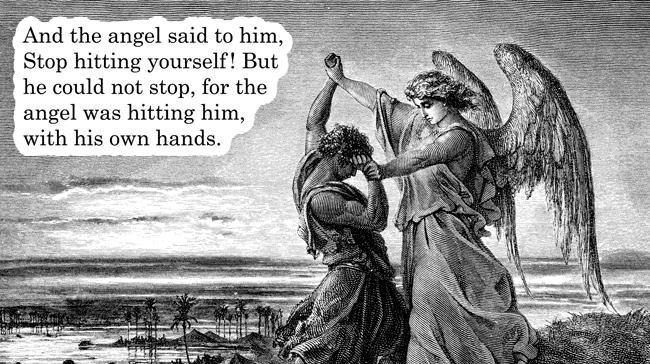
“Stop Denigrating Yourself”

Why does Lloyd (and Dan Savage) seem to suggest that the knowledge that female orgasm isn’t an adaptation might comfort women who experience frustration at an inability to do during sex – or at all – and have wider social implications (despite claiming she doesn’t think people should be deriving social norms from biology – but look, it’s natural that… so we should…)? Perhaps she hopes to make the point that society puts too much pressure on women to orgasm during sex, even though many of them probably won’t – at least not without some manual help – and that pressure makes people feel bad.

As I mentioned previously, no arguments for or against legal rights for homosexuals should turn on the genetic nature of the trait. I don’t think the gay community or their supporters would be comforted at the lack of rights afforded to homosexuals on the grounds that homosexuality isn’t an adaptation, or entirely “in the genes”, and they’d be less distressed if they stopped caring about having them. Similarly, in terms of the social or personal importance of female orgasm, nothing should turn on whether it’s an adaptation or a byproduct.

Strangely, it seems that it does for many people. It might be the case that “adaptation” and “byproduct” have just become placeholders for “genes” and “environment” – that classic false dichotomy – or something similar. For those people, calling a trait an “adaptation” is akin to saying it’s genetically determined and inflexible to environmental influences. This could be a byproduct of the same essentialist state of mind that tells us if we plant an apple seed in a field with pear seeds, it will still grow into an apple tree, not a pear one, or if we paint a lion so it looks like a leopard, it’s still a lion.

That probably also means people are more inclined to think of behaviors they want to encourage – or avoid blame for – as adaptations, and behaviors they want to discourage – or blame others for – as byproducts above and beyond what evidence suggests. As people are generally blind to their own biases, and tend to disagree on matters of morality, the debate about adaptations and byproducts, genes and environment, will continue to thrive and be filled with colorful rhetoric, leaving us to ask “You mad, bro?”

Descartes’ Balls

As I mentioned in the last post, I think a good deal of opposition, to evolutionary theory in general and evolutionary theory when directed towards psychology specifically, is due to a certain fear of moral exculpation, with other concerns about evidence or method being post-hoc rationalizations for that unease. For some, the human mind is somehow different, escaping either the need for an evolutionary analysis or the ability to be explained by one. There are those, like Rene Descartes, who think that the human mind – or at least parts of it – is not even a physical thing to begin with, but rather some immaterial essence.

With a haircut like that, it’s probably a good idea to downplay physical features.

Today, I’ll talk about this man’s balls.

If Rene was anything like the average man alive today, his balls probably weighed between 40 to 50 grams, accounting for about 0.08% of his total – and very material – body’s mass (Smith, 1984; Dixson, 2009). For the percentage of you who aren’t either still giggling at the thought of balls (which accounts for roughly 100% of the men reading this) or questioning my sexuality, you might be curious why normal people would care about the size of balls in the first place.

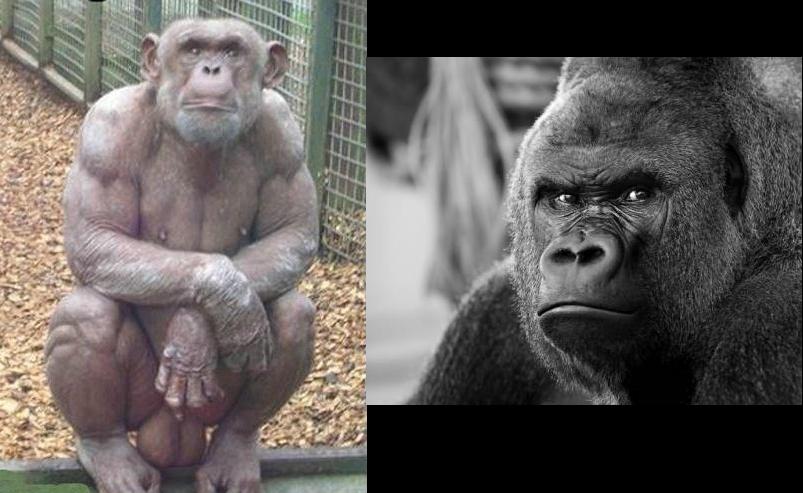
To sate that curiosity of balls, there are many more balls to consider, but let’s just stick to two groups: the balls of some of our close evolutionary relatives, the chimpanzee and and gorilla. 

Warning: one of these pictures contains a graphic depiction of huge balls…wait, where are “warnings” supposed to go?

The chimp’s balls weigh in at an impressive 120-150 grams, whereas the gorilla’s come in at a combine 30ish. While the chimp may out-ball the gorilla by 4 or 5 times, that difference is actual an underestimate, as the gorillas are far larger in overall body size. When we adjust for the differences in body size, the gorilla’s balls account for a mere 0.031% of their body weight, whereas the chimp’s balls account for about 0.3% of their body weight. Pound for pound, chimps have about 10 times as much in their sack as gorillas. 

Sure, the TruckNutz may look big, but once you take the mass of the vehicle into account…


So where does all this talk of balls leave us? It helps to know one last fact: the size of the testes, relative to the body, correlates to patterns of mating – not to their ability to kickass, as many men seem to think. When the sperm from more than one male are in contest to fertilize the same egg(s), we, in the creative names department, call it sperm competition. The gorillas, with their tiny ball-to-body size, face almost no sperm competition; they typically mate in a polygynous fashion, where one dominant male has uncontested sexual access to a harem of females. Chimps, on the other hand, live in multi-male/multi-female groups and, while the females are certainly not without preference, they mate in a far more promiscuous fashion.

What about humans? We’re certainly less ballsier than chimps – by about 400% – but definitely ballsier than gorillas – by about 300%, which tells us our species has probably faced some degree of sperm competition over our evolutionary history, milder than chimps but more intense than gorillas. Knowing these facts help guide us towards some potential conclusions about the human mind, bringing us nicely back to Descartes.

Rather than viewing the body and mind as two distinct pieces, the body can help inform us as to the psychology of the species; our bodies (and minds) are kind of like time capsules of evolutionary pressures. Without females historically mating with more than one male within her fertile window, or without males forcing copulation, there would be no potential for sperm competition. Of course, without females desiring to mate with more than one male and/or males desiring to mate irrespective of the female’s wishes, no selection pressure would exist either.

Which reminds me how one of my professors – at the graduate level, no less – was trying to account for sex differences in behavior by simply appealing to body size differences between men and women, rather than differing psychologies. What he appeared to forget is that those body size differences require an explanation in the first place, and that explanation will ultimately returns to differences in psychology. Having the tools available without the will or knowledge to use them isn’t much better than not having the tool at all, and vice versa.         

(For those interested folk who like looking at naked organs, I’m told this is a comparison between a chimp’s balls and brains)

References: Dixson, A.F. (2009). Sexual Selection and the Origins of Human Mating Systems. New York, NY: Oxford University Press 

Smith, R.L. (1984) Sperm Competition and the Evolution of Animal Mating Systems, New York, NY: Academic Press.

We’re All Evolutionary Psychologists

“A scientific theory tends to go through four stages before it’s accepted: (1) it’s wrong; (2) it could be right, but it’s dangerous; (3) it’s right, but trivial; (4) that’s what I’ve said all along” – Paraphrased from some source I forgot. 

If you happen to think evolution is true, you also happen to be an evolutionary psychologist (implicitly, in that you should conclude our brains are the product of the same evolutionary process that all life is). Every statement about the function (or lack of function) of our – or any other species’ – psychology is a statement about selection pressures and adaptations, however implicit. Some of these theories are not very good – the blank slate comes to mind -  or very explicit, but they all deal with the same underlying questions: what were the selective pressures on a species? How did said species evolve to deal with these pressures?

According to some, at some point in this process the entire process stopped mattering.

Which is why it’s strange that the term “Evolutionary Psychology” gets thrown around as a type of insult in some groups. For me, it works the other way around; those who actively don’t consider themselves evolutionary-minded researchers are the ones that have the cooties, sit around eating paste, and are to be shunned at playtime. Evolution is true, and its usefulness as a theoretical framework for conducting and understanding research about the human mind and body is well evidenced, so why should anyone actively avoid using it? The reasons for the opposition to evolutionary psychology are numerous on paper, but we can learn about their underlying causes simply by the critics – misguided as they are – speaking for themselves.

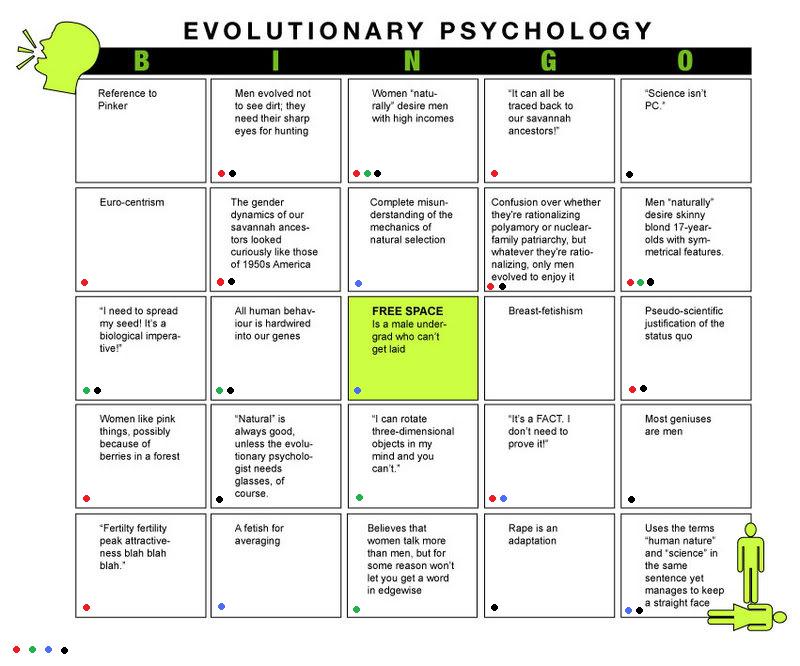
Yes, these are supposed to be actual criticisms. No, I’m not joking.


The colored dots in the bottom-left of each box represent a general category I see the criticism falling into: Red indicates “Just-So Story” criticisms; Green indicates charges of genetic determinism; Blue indicates attempts to distance the authority of “science” from EP; Black indicates a charge that EP will justify morally distasteful actions, also known as the naturalistic fallacy. While these four categories don’t wholly encompass the areas criticisms fall into, I think they’re an alright – if rough and perhaps arbitrary – start. (Edit: There is an additional category criticisms generally fall under: Conflating proximate and ultimate explanations, nicely summed up by quotes like this one. “Wanting to prevent sexual assault is evolution, instead of, like, wanting not to be assaulted.”

There was a certain amount of guess-work (or interpretation, if you want to put a positive spin on it) that went into my classifications: some of those criticisms are just stupid in a relatively straightforward way, while others are stupid in several ways, or stupid in ways that aren’t quite clear and I had to infer the intentions of the person writing them. By no means should these be taken as set-in-stone (unless it happens to agree or disagree strongly with your existing thoughts, in which case it probably will be).

The first thing I’d like to call attention to is that evolutionary psychologists – or those who defend the field – are portrayed as male (center square and bottom-right corner, the latter of which sends a pretty clear message). One could be left wondering why, considering that the majority of people working in the field are politically left-leaning women (about 65%, which is not significantly different from the 70% of women in other fields of psychology; Tybur, Miller, & Gangestad, 2007). Perhaps men are more vocal in their defenses of the field or are just better known. Perhaps it has something to do with the social views and goals of the person doing the critiquing. I can’t say for sure. 

The second thing to consider is breakdown by criticism: 11/25 squares deal with “Just-So” storytelling, 6/25 squares deal with genetic determinism, 4/25 squares deal with a lack of scientific rigor, and a whooping 13/25 squares deal with matters of moral justification or sexism, though I consider that 13/25 to be a conservative estimate; I can think of at least 4 more squares it might apply to.


What could these rough figures – and I do stress rough – potentially tell us about the opposition towards EP? The anecdata point towards the following picture of what the stereotype of an evolutionary psychologist is: men who are trying to justify their nasty and dominating behavior by claiming their genes determine their actions, always have, and always will, so there’s no point to try and change the “natural” order of things.

The people behind this BINGO board are winning at the pop anti-evolutionary psychology game

I don’t think it’s a coincidence that the critics of adaptationist thinking often appear more aggressive towards the methods involved when applied to humans – as opposed to non-humans – nor is it just a string of chance happenings that the majority of the criticisms appear to mention perceived negative traits (violence comes to mind, though it could be any idea the author finds distasteful) rather than perceived positive or neutral ones.

Finally, I’m struck by the resemblance of the opposition towards evolutionary psychology specifically to the opposition towards evolution more generally: “evolutionary theory says there’s no such thing as morality and everything is permitted”; “you can’t test what happened in the past, so it’s not science”. There are many people who think evolution is true, but back off once they hit the human mind, much like Alfred Russel Wallace did.

Sounding familiar at all?

References: Tybur, J.M., Miller, G.F., &  Gangestad, S.W. (2007). Testing the Controversy: An Empirical Examination of Adaptationist’s Attitude Towards Politics and Science. Human Nature, 18, 313-328


Smoke Detectors With Benefits

I hate my smoke detector. Right now it’s laying disassembled on the table in my living room because it apparently thought my chicken was a fire hazard. That I’m talking about my smoke detector as having thoughts in the first place is rather odd, but it’s just a metaphor that we all understand, right? It’s not like people ever direct aggression, real or imagined, against tools that aren’t working as you’d prefer.

A man who may or may not understand the proper use of metaphor

From computers, to cars, to imagined supernatural beings, people see agency where none exists – if not directly “see” it, then act as if they do. They will curse them, direct physical aggression towards them, and they will plead with them. Even though most people will tell you they understand begging their car to not run out of gas won’t actually affect how far the car will eventually travel, one can imagine – has perhaps even experienced – the satisfaction some people get from breaking an old, less-than-functional piece of equipment because it was out to make their life miserable (the fax machine from Office Space comes to mind).

Part of what we see going on here is like my smoke detector problem (also known as Error Management Theory). The intended purpose of a smoke detector is to warn someone about an actual fire by using a typical cue that a fire would give off – the smoke. Needless to say, this also makes the smoke detector have the annoying habit of going off when something is cooking/burning – or in my case, having the stove on (my smoke detector is particularly annoying). One way to avoid this irritation would be to make smoke detectors less sensitive so they wouldn’t go off during cooking dinner and all-night bong parties. However, doing so runs the risk of not making it sensitive enough to go off when there’s a real fire, or not going off until it’s too late. This doesn’t mean that the best course of action is to turn up the sensitivity all the way, otherwise it would go off constantly, making the false alarms far too annoying; the key is finding that happy medium.

In the case of inanimate objects being labeled as enemies, part of the issue could be an agency-detection module in our brain getting triggered by an inappropriate stimulus because of the way it’s calibrated: to be more sensitive to potentially important cues in order to avoid missing them. It’s better to just be startled by what you thought was movement than to miss real movement that could mean real harm. In other cases, modules for aggression or negotiation could be triggered by the frustration of one of our goals, like being unable to fax a letter or view pornography quickly enough. While those behaviors might be useful ways of dealing with social creatures, they also get inappropriately recruited for some non-social ones.

Something similar can be seen happening between men and women’s perception of sexual interest. In the case of a smoke detector, both sexes are open to the same cost and benefits of false alarms and real fires; in the world of mating, this isn’t always the case. It would be costlier for men – in terms of reproduction – to miss signals of potentially sexually interested women than the reverse. According to Buss (2003), this would explain why men are far more likely to infer sexual interest in women who are smiling at them or touching them (or talking to them, hanging out with them, sending them nude pictures, being alive, etc).  In case there are any women out there who haven’t figured this out yet, almost all of your guy friends are waiting for you to come around and see things their way, they’re just a bit more patient than the drunk guy at the bar.

“I couldn’t help but noticed I touched your ass while you were dancing. Do you have a phone number?”

Perceptions of attractiveness are another area where the sexes would appear to differ. According to Okcupid – which is a reputable source of scientific data when I find it convenient – women tend to differ in their appraisals of male attractiveness, rating the vast majority of men as being below average in attractiveness. This statistical impossibility could be reflective of the fact that a “wrong” mating choice on the part of a woman is reproductively costlier on average than the wrong choice on the part of men. Or maybe it’s all because of this nasty “culture” going around. Yeah, let’s go with that….

References: Buss, D.M. (2003). The Evolution of Desire: Strategies of Human Mating (Revised Edition). New York, NY: Basic Books.   

Blame And Intent

The vice president of a company went to the chairman of the board and said, “We are thinking of starting a new program. It will help us increase profits and it will also harm the environment.” The chairman of the board answered, “I don’t care at all about harming the environment, I just want to make as much profit as I can. Let’s start the new program.” They started the new program. Sure enough, the environment was harmed.

How much blame do you think the chairman deserves for what he did (from 0-6)? Did the chairman intentionally harm the environment?

Those were questions posed to the people who read the story quoted above (Knobe, 2003). If you’re like most people, you’re probably basking in some sweet moral outrage right about now at the thought of the hypothetical chairman’s action; the kind people of fantasy-land will have to drink from polluted rivers, leading to the death of imaginary fish populations, harming the livelihood of the poor fishermen who were going to kill them anyway, and they all have the chairman to thank for it. To make the example a little more real, think about how certain economies recently took a big hit due to shady business practices, leading to some people occupying Wall Street getting a face full of pepper spray. 82% of participants said the chairman acted intentionally, and deserved to be blamed at about a 5 on average.

So now that we’ve established that the chairman definitely should be blamed for what he did since he was acting intentionally, do me a favor: go back to the original quote and read it again, replacing “harm” with “help”, then answer those first two questions, just replacing “blame” with “praise” and “harm with “help” again.

If you’re anything like me, you’re probably really handsome. If you’re anything like the participants in the study, your answers to the questions probably did a 180; of course the chairmen doesn’t deserve praise for what he did and he certainly didn’t act intentionally. In fact, 77% of participants now believe the chairman did not act intentionally and deserves to be praised at about 1.5.

Remember how I said people are bad at logically justifying their decisions and evaluating evidence objectively?

Let’s consider these results in light of the moral wiggle room research I presented last post. When the dictator can choose between a similar interest $6/$5 option or a $5/$1 option, they probably won’t be judged positively, no matter which they choose; if they pick the first option, well that was in their interest anyway so the judgment should be neutral, and if they pick the second, they’re just a spiteful dic…tator.  When someone has to choose between the conflicting payoffs, either $6/$1 or a $5/$5 split, they probably have a chance for some social advancement in the latter choice -it’s only moral if you give something up to help someone else – but plenty of room for moral condemnation with the former.

What would people’s judgments be of dictators who had the $6/$? or a $5/$? payoff and chose to not know? My guess is that it would fall somewhere between the neutral and negative side, closer to the neutral side. Even though their reputation may suffer somewhat due to their willful ignorance, people seem to take definite harm into account more than potential harm (drunk drivers suffer lower penalties than drunk drivers who hit something/someone by accident, essentially meaning it’s more “against the law” to be reckless and unlucky than just reckless. Judging actions morally by their outcomes is another topic, no less interesting).

But what about the poor, misunderstood dictators? I’d also guess that the dictators would rate their behavior quite differently than the crowds of people with colorful signs and rhyming chants about who or what has “got to go”. Those in the similar interest group would probably say they behaved morally positively and did so intentionally – and who are we to question their motives? – as would those in the conflicting group who chose the $5/$5 split. The ones who chose the $6/$1 would probably rate their behavior as neutral, justifying it by saying it was an economic decision, not a moral one. Those in the ignorant condition would probably rate their behavior somewhere between morally positive and neutral, after all, they didn’t intentionally hurt anyone, nor do they know they even hurt anyone at all, so, you know, they’re probably upstanding people.

References: Knobe, J. (2003). Intentional Action and Side Effects in Ordinary Language. Analysis, 63, 190-193

Red Herrings And Moral Wiggle Room

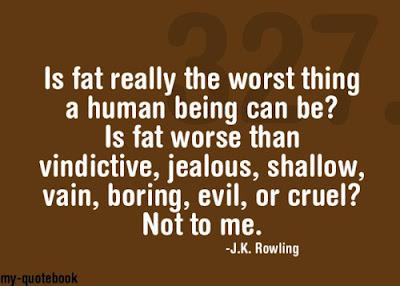
I don’t know whether it was actually J.K. Rowling who wrote/said that, but as a shallow, vain, and boring person who also happens to be in great shape, this quote really speaks to me; no doubt it also speaks to the deeper, selfless, and interesting portion of the population who read the quote surrounded by stacks of old pizza boxes and empty cartons of Ben and Jerry’s, but I get the sense it speaks to us in different ways (I also get the sense my keyboard is substantially less sticky).

Whoever is being quoted would appear to be implying something like the following: “Someone might be unhealthy/unattractive, but they could be X instead, which is worse. Therefore, being fat is OK”.  The logical shortcomings of that implication are so vast that the author has either never taken a philosophy class or has a PhD in the subject. I’d doubt Rowling’s(?) commitment to that line of thought in any case, simply by pointing out the actors in the Harry Potter films are less than fat – far less so than the population at large – meaning plenty of good actors probably got passed over because they were fat. More importantly, the entire quote is a red herring; a statement intended to distract attention away from the matter at hand.

Consider an alternative, but similar statement: Is a little thievery the worst thing someone can do? Is it worse than murder, rape, or physical assault? Not to me. The problem should become apparent here very quickly; whether or not Y is worse than X should have no bearing on the status of X. Whatever X is, it needs to be able to stand on its own feet. There is one case where there is an exception, and that’s concerning a certain parking ticket issued to me. Parking police, go fight some real crime. There are bigger concerns out there than whether I probably accidentally parked in a handicapped spot for a few hours. I already had to get my car out of impound; isn’t that enough for you people? It’s not like I was drunk driving. Or fat.

So  what does this quote tell us about how human psychology functions? One potential lesson we could take from it is that people are bad at justifying things coherently (see my last post, and probably future ones). Of greater interest, however, is the fact that people are interested in justifying their behavior as intensely as they are.

I remember seeing a commercial for yogurt on TV not so long ago that made fun of this bit of peculiar psychology. A woman is seen standing in front of a fridge, eying some cake. She thinks to herself that she could eat some celery and the cake, and somehow the celery would cancel the cake out. Women; am-i-right fellas? She wants to eat that cake and is trying to justify doing so to herself. There are two things to say about that: first, it’s great evidence for modularity of the mind, as if anymore was needed. Second, what good could those justifications possibly be? (They certainly don’t work out all the time)

To start at answering that question, let’s examine some research by Larson and Capra (2009) on the subject of what’s called “Moral Wiggle Room”. The research involved a dictator game; it’s a classic economic research design in which one player is designated the “dictator” and another player is designated to lie there and take it…. I mean, the “receiver”. The dictator is given a sum of money, say $10, and the ability to decide how the money is to be divided. Whatever the dictator decides is what goes, so if the dictator wants to keep $9 and give $1 to the receiver, so be it. Not only is it a neat way to examine certain aspects of our psychology, but it’s also an effective way of disappointing people in the name of science. Talk about killing two birds with one stone.

Research on Moral Wiggle Room goes (basically) as follows: In one group, the dictators need to decide between a higher payoff for themselves and a lower payoff for someone else, or a lower payoff for themselves that gives the receiver more money (A $6/$1 option or a $5/$5 option), or between payoffs that benefit both parties ($6/$5 option or a $5/$1 option). Another group of dictator’s payments look like the following: $6/$? or $5/$? While these dictators don’t know up front what the receiver will get, they can find out for free. With the click of a button, they can reveal the payoffs; it costs nothing in terms of time or money to find out. So what do people do?

In the first group, where payments are known, about 75% of dictators choose the fair option, so maybe life in the Soviet Union really wasn’t that bad. What happens when dictators are given the choice to not know how their actions will affect others? Slightly more than half of them choose to remain ignorant and not reveal the payoffs; of that 50%, who didn’t reveal, 100% took the higher offer. (The ones who revealed weren’t exactly saints either, since over half took the higher payment at the expense of the receiver)

Why might people not want to know how their actions effect others, even when it costs nothing to know? For starters, being strategically ignorant can only help them in terms of payoff: best case scenario, they find out the option that’s better for them is better for someone else as well  and they take it anyway; worst case, they now have access to information that opens possibilities for creating expectations of certain treatment in which their wallets are now a slightly lighter (in theory anyway. While these games are played anonymously, we’re all still sitting here judging their actions to ourselves, demonstrating the point). However, by remaining ignorant, they can also honestly claim they didn’t know they were making someone worse off. This could allow them to benefit indirectly (they may be able to better persuade others that they’re morally upstanding citizens or avoid punishment for their actions more effectively, should they come to light, without needing to lie about it) in addition to the direct benefits (they made more money).

Of course, these games are played at low-stakes, information is free, easy to obtain, and unambiguous, while decisions are made anonymously. One could think of how the results could change when any of those factors do. While things can get messy quickly, there are clearly cases in which the reasons for not knowing are better than knowing for some. My guess is that those reasons center around persuasion through justification, specifically being able to convince people that what you did was OK because you didn’t know how other people would feel. While that argument happens to be a red herring in the case of the research reviewed here – they could have found out if they wanted – we should not forget that red herrings are used as often as they are because they have a habit of working. And by working, I mean they can help make people forget you’re full of shit because they’re looking somewhere else.

References: Larson, T. & Capra, C. M. (2009). Exploiting moral wiggle room: illusory preference for fairness? A comment. Judgment and Decision Making, 4, 467-474.

I Read It, So It Must Be True

The first principle [in science] is that you must not fool yourself, and you are the easiest person to fool – Richard Feynman

It feels nice to start a post with a quote from some famous guy; it just makes the whole thing that much more official. I decided to break from my proud, two-note, tradition and write about some psychology that doesn’t have to do with gay sex, much to the disappointment of myself and my hordes of dedicated fans. Instead, today I’ll be examining the standards of evidence with which claims are evaluated.

Were we all surveyed, the majority of us would report that we’re – without a doubt – in at least the top half of the population in terms of intelligence, morality, and penis size. We’d also probably report that we’re relatively free from bias in our examination of evidence, relative to our peers; the unwashed masses of the world, sheep that they are, lack the critical thinking abilities we do. Were we shown the results of research that said the majority of people surveyed also consider themselves remarkably free of bias, relative to the rest of the world – a statistical impossibility – we’d shake our head at how blind other people can be to their own biases, all the while assuring the researcher that we really are that good.

I think you see where I’m going with this, since most everyone is above average in their reasoning abilities.

In some (most?) cases when evidence isn’t present, it’s simply assumed to exist. If I asked you whether making birth control pills more available would increase or decrease the happiness of women, on average, I’d guess you would probably have an answer for me that didn’t include the phrase “I don’t know”. How do you suppose you’d respond if you read about some research evidence that contradicted your answer about it?

In real life, evidence is a tricky thing. Results from almost any source can be tainted from any number of known and unknown factors. Publication bias alone can lead to positive results being published more often than null results, leading to an increase in the number of false positives, not to mention other statistical sleights of hand that won’t be dealt with here. The way questions are asked can lead respondents towards giving certain answers. Sometimes the researchers think they’re measuring something they aren’t. Sometimes they’re asking the wrong questions. Sometimes they’re only asking certain groups of people who differ in important ways from other people. Sometimes (often) the answers people give to questions don’t correspond well to actual behavior. There are countless possible flaws, uncontrolled variables, and noise that can throw a result off.

Here’s the good news: people are pretty alright at picking out those issues (and I do stress alright; I’m not sure I’d call them good at it). Here’s the bad news: people are also substantially worse at doing it when the information agrees with what they already think.

Two papers examined this tendency: Lord, Ross, & Lepper (1979) and Koehler (1993). In the first, subjects were surveyed about their views regarding the death penalty and were categorized as those who were either strongly in favor of it or strongly opposed. The subjects were then given a hypothetical research project and its results to evaluate; results that either supported the usefulness of the death penalty in reducing crime or opposing its usefulness. Following this, they were then given another study that came to the opposite conclusion. So here we have people with very strong views being given ambiguous evidence. Surely, seeing the evidence was mixed, people would begin to mellow in their views, perhaps compromising to simply breaking a thief’s hands over killing him or letting him escape unharmed, right?

Well, the short answer is “no”; the somewhat longer answer is “nooooooo”. When subjects rated the research they were presented with, they pointed out the possible ways that the research opposing their views could have been misconducted and why the results aren’t valid to their satisfaction. However, they found no corresponding problems with the results that supported their views, or at least no problems really worth worrying about. Bear in mind, they read this evidence back to back. Their views on the subject, both pro and con, remained unchanged; if anything, they became slightly more polarized than they already were at the beginning.

Koehler (1993) found a similar result: when graduate students were evaluating hypothetical research projects, those research projects that found results consistent with the student’s beliefs were rated more favorably than those with opposing results. We’re not just talking unwashed masses anymore; we’re talking about unwashed and opinionated graduate students. There was also an interaction effect: specifically, the stronger the preexisting belief, the more favorably agreeing studies were rated. A second study replicated this effect using a population of skeptics and paranormal researchers examining evidence for ESP (if you’re curious, the biases of the paranormal researchers seemed somewhat less pronounced. Are you still feeling smug about the biases of others, or are you feeling the results aren’t quite right?).

The pattern that emerges is that bias progressively creeps in as investment in a subject increases. We see high-profile examples of it all the time in politics: statistics are often cited that are flimsy at best and made up at worst. While we often chalk this up to politicians simply outright lying, the truth is probably that they legitimately believe what they are saying is true, but it could be something they accepted without even looking into it, or looking into the matter with a somewhat relaxed critical view.

And before we – with our statistically large penises and massive intellect – get all high and mighty about how all politicians are corrupt liars, we’d do well to remember the research I just talked about didn’t focus on politicians. The real difference between non-politicians and official politicians is that the decisions of the latter group tend to carry consequences and are often the center of public attention. You’re probably no different; you’re just not being recorded and watched by millions of people when you do it.

Recently, I had someone cite a statistic at me that the average lifespan of a transsexual was 23 years old. As far as I can tell, the source of that statistic is that someone said it once, and it was repeated. I’m sure many people have heard some statistics about how many prostitutes are actually being coerced to work against their will; you might do well to consider this. Many are probably familiar with the statistic that women earn 75 cents to every dollar a man earns as a result of sexism and discrimination. Some of you will be pleased to know that discrepancy drops very sharply once you actually start to control for basic things, like number of hours worked, education, field of work, etc. Is some percentage of whatever gap remains due to sexism? Probably, but its far, far smaller than many would make it out to be; the mere existence of a gap is not direct evidence of sexism.

Not only are unreliable statistics like those parroted back by people who want to believe (or disbelieve) them for one reason or another, but the interpretations of those statistics are open to the same problem. I’m sure we can all think of times other people made this mistake, but I’ll bet most of us would struggle to think of times we did it ourselves, smart and good looking as we all are.

References: Koehler, J.J. (1993). The Influence of Prior Beliefs on Scientific Judgments of Evidence Quality. Organizational Behavior and Human Decision Processes, 56, 28-55.

Lord, C.G., Ross, L., & Lepper, M.R. (1979). Biased Assimilation and Attitude Polarization: The Effects of Prior Theories on Subsequently Considered Evidence. Journal of Personality and Social Psychology, 37, 2098-2109.

OKCupid Blog: Gay Vs. Straight Sex

I’m of the mindset that gay men and women are pretty much just like straight men and women, the real difference being their preference for which gender they find attractive, which is why the following presentation struck me as interesting:

Their sample size was 3.2 million, which is pretty fucking impressive. The thought of having access to the data set they do is sexually thrilling for me (perhaps we could tack another letter onto the end of LBGT for people with my proclivities), so I decided to do another edition of Pop Psychology to take a closer look at what our Okcupid blogger decided to present from that data set and raise some questions that will remain unanswered, but serve as practice (for me, anyway) for critical evaluation. After all, having access to something so amazing demands that it not be squandered or misused.

The first question I’d pose is about that impressive sample size itself: what percentage of it represents straight/ gay men and women? You’d think, this being an article about straight vs. gay sex, that would be the first thing they’d mention. If we assume population level frequencies, that would mean that sample is about 1.6 million men and women total, about 80,000 of which will be gay men (5%, published range from 3-10%) and about 40,000 of which will be lesbian women (2.5%, published range from 1 – 3%). That is assuming we can assume population levels; there is no data presented concerning the the percentage of Okcupid users who identify as straight or gay in the first place. I’m sure the Okcupid people have this data available, but it’s not shown here for whatever reason. Since it’s not shown, there’s no way of inferring whether this population is representative or not, which could throw a possible wrench into its interpretation. I’m not saying it does, just that it might.

Let’s start by looking at the first point raised by the article:

Gay people are not sexually interested in straights.    

Match Search Returns

  • only 0.6% of gay men have ever searched for straight matches.
  • only 0.1% of lesbians have ever searched for straight matches.

What that tells us is that most gay and lesbian people do not go looking explicitly for straight people on the website, which is pretty expected, especially when people’s sexual orientations are readily visible. What that does not tell us is is that gay people are not sexually interested in straight people; I assume most of them are, and I assume that for the same reason that most heterosexual men are sexually interested in lesbians, even though they’ll probably never sleep with them (but more on that in a bit). I have found that knowing a woman’s sexual orientation has not made me any more or less attracted to them, though it does affect my judgments of whether or not I’m likely to have sex with them. I imagine other people don’t need to know someone’s sexual orientation before they feel any sexual attraction, nor do I feel that knowledge would do much to change that attraction. The website just allows for screening based on sexual orientation, skipping what would be an in-person trial and error process, since not everyone has their sexual orientation tattooed on their forehead.

Those absolute percentages are very small, granted, but they also tell us something else: relatively, gay men are six-times as likely to have ever searched for straight men than lesbians are to have searched for straight women; an interesting finding to be sure. Bear in mind those numbers refer to people who have ever searched for a straight match, not how frequently they do it. My guess is that gay men also search for straight matches more frequently, but without the data available I can’t say with any certainty. Moving on:

Gay people aren’t promiscuous.

Median Reported Sex Partners

  • straight men: 6
  • gay men: 6
  • straight women: 6
  • gay women: 6

This stuck out to me above everything else in the article because it stands in stark contrast to everything I’ve ever read in the published literature. Simply put, men and women (straight ones) don’t report identical numbers of sexual partners, generally speaking, and men and women (gay ones) don’t report identical numbers of sexual partners. Has Okcupid, with its huge data set just blown all those other results out of the water? I don’t think so; consider the following number sets to understand why:

(1) 0, 0, 1, 3, 5, 6, 10, 30, 100
(2) 3, 3, 3, 3, 5, 7, 7, 7, 7

If we assume those numbers represent number of sexual partners, then in both samples, the median (the middle) number of partners is 5; the mean (the average) number of partners is still 5 for sample (2), but in (1) it’s 17.22. See the very big difference? Most every study I recall reading reports the mean, and if they report the median at all, it’s in conjunction with the mean. That the Okcupid post only reports the median at best doesn’t allow them to make the statement they did, and at the worst reeks of spin to attempt to make groups look  more similar than they actually are.

There are two other problems: the first is that those numbers refer to number of partners, not number of same/opposite sex partners. It’s not uncommon for lesbians to have several male partners (in some cases, more male partners than female ones), and that can matter a lot (especially because the same isn’t true of gay men).
The second problem, again, returns to the sample itself: the age of these people are not reported. Older people tend to have more sexual partners than younger ones, simply because they’ve had more time to rack up the numbers. Gay men tend to report establishing a clear sense of their orientation before lesbians, which could mean our lesbian sample is substantially older. Perhaps they controlled for this, but if they did, they make no mention of it (they do mention controlling for things in other blog posts, so I can only assume they did not here).

  • 45% of gay people have had 5 or fewer partners (vs. 44% for straights)
  • 98% of gay people have had 20 or fewer partners (vs. 99% for straights)

What is curious about this is that the previous stats had broken down the data by gender and sexual orientation; here, we see it recombined to just sexual orientation. I can’t think of any good reason to do that from a strictly informative point of view, which implies to me there’s probably something else going on (namely, controlling the light in which these findings are presented).
While those differences in percentages appear small absolutely, as was the case previously, they can also be read to say something else: gay people are twice as likely to have more than 20 partners, relative to straight people. I also assume that effect is largely being carried by the male portion of the gay side, which could potentially mean that gay men are up to four-times as likely to have over 20 partners, depending on what percentage of that gay 2% and straight 1% are men. So gay men could be somewhere between 2-4 times as likely to have over 20 partners, relative to their straight counterparts, which strikes me as more promiscuous.On that note:

we found that just 2% of gay people have had 23% of the total reported gay sex, which is pretty crazy.

An interesting finding to sure, but the same probably holds for straight people. Male numbers of sexual partners (straight) are distributed differently from female numbers; there are a small number of men with a large number of sexual partners along with many men that have low numbers to no number at all. On the other hand, women are less likely to have the peaks that men do in the high end, but they’re also less likely to be shut out of the game entirely (fewer women with no numbers). Accordingly, if this was broken down by gender, I’d predict that most of that effect was being carried by gay men, not lesbians.

However, since we are dealing with a single gender in the case of gay men or women, the distribution curves would have to look different from their heterosexual counterparts: either the peaks of the gay community would have to be smaller than those of the straight community and the distribution more even, or larger numbers of gay men and women would not have (m)any sexual partners. Since we already know from the previously reported data that, at the upper end of 20+ partners, gays outnumber straights 2-to-1, that would require more gays not having, relative to straight people. That would mean, cutting off the top end of the distribution, the gay community should be even less promiscuous than the straight community, on average.

Then again, perhaps gay men are more promiscuous all around (which would simply shift the graph up), while lesbians are less so (shifting the graph down), but that article seems to imply that’s an unfair stereotype.

So there are good reasons to doubt the statement that promiscuity is equal across the four combinations of straight/gay men/women; it’s very expected, and established, the that groups are not the same sexually (men are not women, and women are not men). However, there are two more possibilities that the article doesn’t touch on that I think could underestimate the extent of gay promiscuity.

The first is the social risks openly gay people may face, which could result in them being less willing to try to hit on people they otherwise would like to. In that sense, it’s not that homosexuals are less promiscuous then they’d prefer by choice.

The second is the size of the dating/mating pool that gay men and women have to deal with; were only 2.5% of the population potentially sex-able to me (50% aren’t men, and of that 50% that are men, only about 5% are gay, and of that 5%, not all will be attractive), I’d either have to know many, many more people than average to reach the average number of sexual partners, or be particularly more motivated to make it happen, provided that 2.5% was no more promiscuous than the roughly 50% I have potentially available now. Since I don’t think gay people know substantially more people than straight ones, that raises the possibility of motivation and/or promiscuity.

Of course, none of this says anything about judging the worth of a person by their number or choice of sexual partners. I can’t help but wonder if the people at Okcupid were trying to present the data selectively to make the case that gay people are really just like straight people, which means they’re OK. If they were, they went wrong on two major fronts. The first is that the gay community does not need to be the same as straight people to be OK. They’re already OK; always have been. The second big issue is that for gay men and women to be similar to straight men and women, gay men are going to be different from lesbians along the same lines that straight men differ from straight women. The real differences in behavior emerge because when a man is pairing with other men, their sexual interests tend to converge more than the interests of men with women; that same goes for women pairing with other women. There’s no need for everyone to be identical for everyone to be equal, and trying to present select bits of the data to make them look more the same isn’t helping.